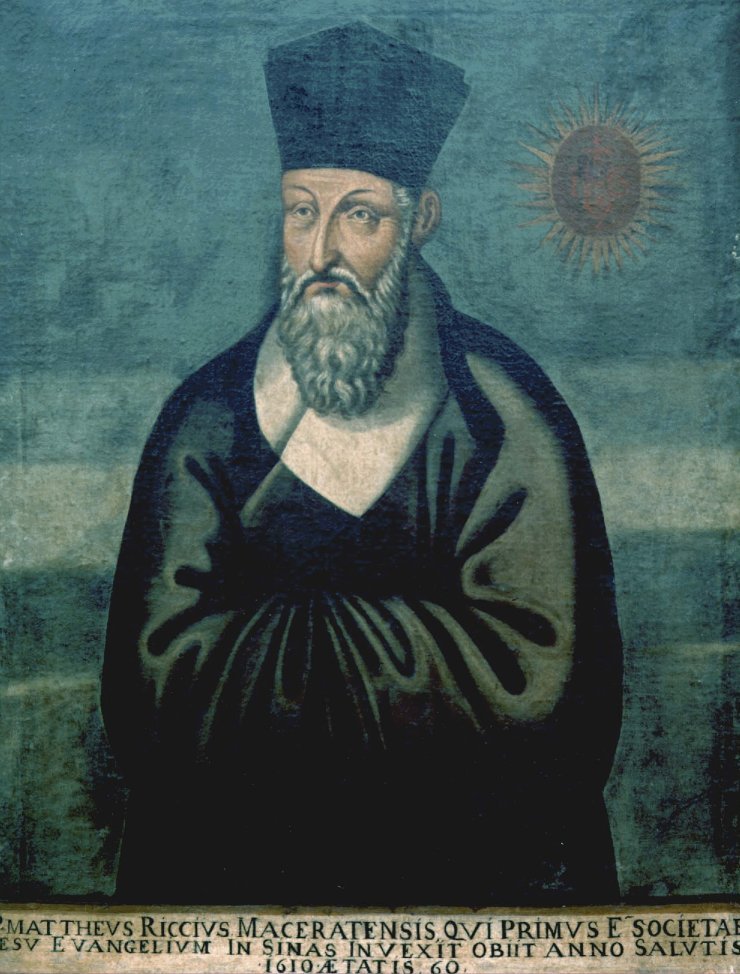
Belgium/China 1623-1688
.jpg)
Ferdinand Verbiest was born in what is now Belgium in 1623 and joined the Jesuit order at age 18. (2) He was ordained in 1655. (10) Originally he wanted to go to South America, but was called to China because of Adam Schall von Bell. (7) He was 35 at the time. After preliminary work in the rural areas, Verbiest was summoned to Beijing to assist Johann Adam Schall von Bell with astronomy. By the time he arrived Beijing, the other Jesuits were imprisoned. Verbiest‘s attempts to free the Jesuits were of no avail and he joined them in the terrible conditions. (1, 7)
However an earthquake struck the wing of the palace where they were to be executed so in 1668 Emperor K’ang Hsi (also known as Kangxi), organized a contest of skill between Verbiest and the Mandarin who had started the persecution. (2, 4, 7) The contest was composed of three parts: to determine the shadow on a sundial on a given day, when a lunar eclipse was to take place, and the location of various planets on a specified date. (2) The losing astronomer was exiled and Verbiest became the President of the Bureau of Mathematics. This new position afforded him an excellent ability to influence the Emperor and the persecution ceased.
Verbiest won both the contest and the favor of the emperor.
He was assigned the board of Mathematics and made a very bold demand; the ‘Perpetual Calendar of the Kangxi Emperor’ must be altered! (7) This was unthinkable. Not only did millions of people use the official calendar, but the emperor himself had approved it! (1) Furthermore, this was no quibbling change, Verbiest wanted to remove an entire month! The officials pleaded with Verbiest to change his futile course of action, but he replied that “It is not within my power to make the heavens to agree with your calendar.” (1)
It was changed.
The emperor liked him and learned whatever Verbiest could teach him. Verbiest translated
six books of Euclid into Manchu, and taught geometry, philosophy and music. The Emperor made Verbiest the highest level of Mandarin, included him on journeys across the Empire and allowed him to preach Christianity. (1) In his efforts to fit in, Verbiest studied Machu and Chinese and took a Chinese name, Nan Huairen. (7)
Being a missionary was Verbiest’s entire purpose for being in China so he leapt at the opportunity and included Christianity whenever he could. (1) Verbiest worked so diligently at his posts because he hoped he could thereby convince the Emperor to become Catholic. (4) Unfortunately this did not occur. Verbiest’s position allowed him much greater influence however, and he was able to reach much farther with his writing and preaching than his fellows as a result. (4) He soon became involved in essentially every project, including the creation of 132 advanced and modern cannon for use by the Imperial Army to stop a rebellion. Verbiest also designed a new type of gun carriage. (1, 4)
Verbiest continued his astronomical work by assembling a table of eclipses, lunar and solar, for the next two thousand years. The emperor was overjoyed with the wondrous progress and promptly made Verbiest in charge of the Imperial Astronomy Observatory. (1)
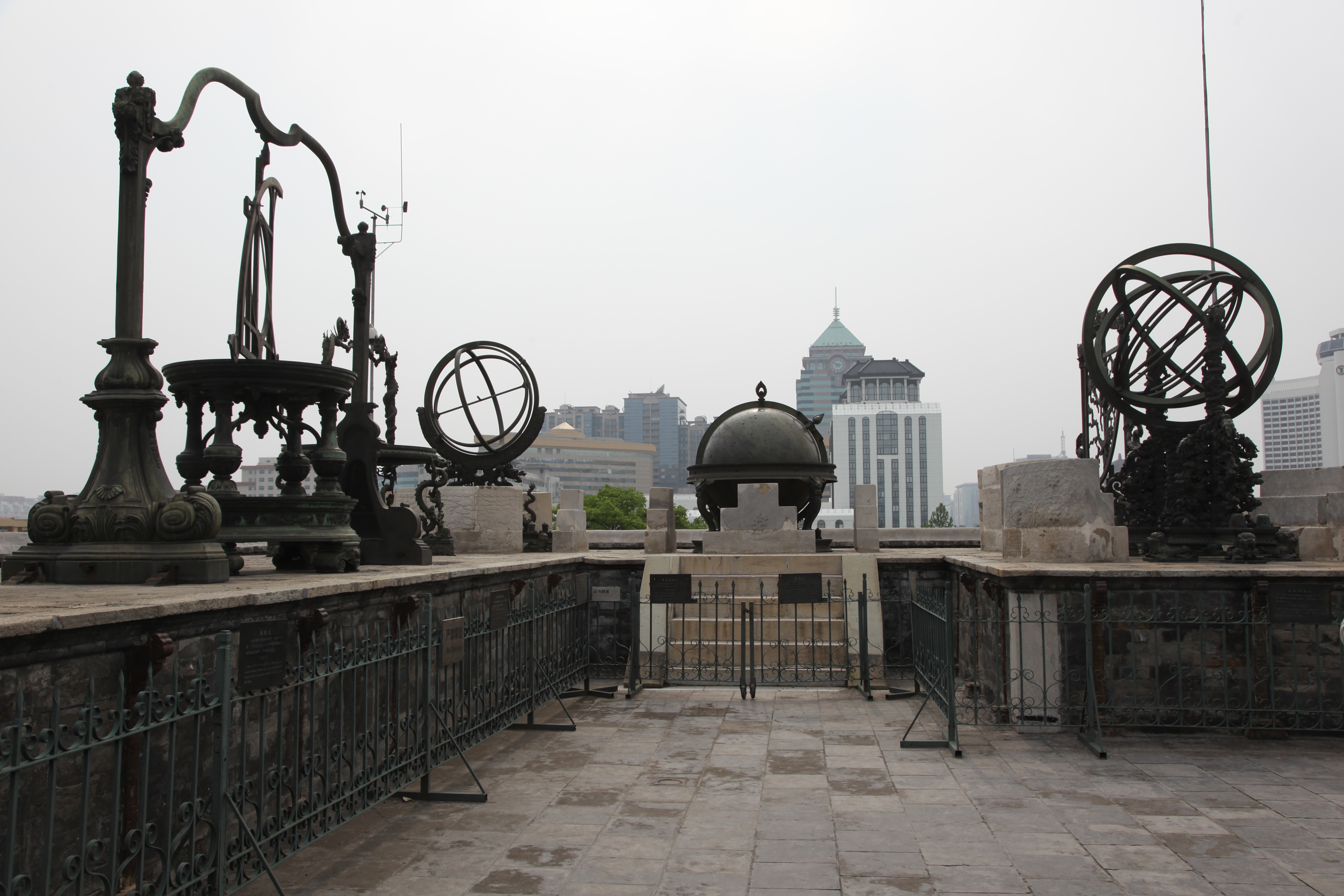
 This post was challenging because the structure had been finished in 1279 and so its instruments were extremely… obsolete. Between about 1669 and 1674, Verbiest faced this challenge by assembling a team of master metalworking artisans to make designs imported from Europe. The final instruments were precise enough to measure fifteen seconds, or a nine hundredth of a single degree. (4, 7)
Verbiest documented his work in a 1674 manuscript titled ‘Disclosure on the Newly-Built Astronomical Instruments in the Observatory’ in which he described the design and function of the instruments very precisely so they could be reproduced. It was such detail that for the six instruments he created it took 16 volumes to contain his descriptions. (7)
He created two separate versions of an armillary sphere, an altazimuth, a quadrant, a sextant, celestial globe. These instruments were then put atop the observatory. It may seem rather odd that such a small amount of instruments could take sixteen volumes to describe. (7) One reason for this apparent oddity is the size of the instrumentation. Each was six feet or more in diameter so they were at least the height of a man, and intricately detailed, including multiple dragons per instrument. (4, 7)
Verbiest created a steam engine for ships, designed pumps, built an aqueduct, created numerous maps, and thirty books. His books covered astronomy, Chinese grammar, and he translated a missal into Chinese as well as producing a Chinese book to explain Christianity in simple terms. (1)
 Verbiest also designed the first car. It was slightly over two feet long and powered by steam, but the idea of having a self-propelling machine was present. (9) The machine carried a contained or water over a bed of coals and the steam was directed at a turbine which provided the power for it to move. (9) Whether it was actually built is an open question, but the designs were completed.
He was also able to simplify Chinese geometry by reducing the number of degrees in a circle from 365.25 to 360. (7) He was put in charge of public works, assisted China in negotiating their border with Russia, and even sent a missal translated to Chinese to the Pope as evidence of his mission. (2)
The Pope sent him a letter congratulating him for his work, and in 1677 Verbiest was appointed head of all Jesuits in China. (4) He recognized the great opportunities open, but also the desperate need for more priests. He urged missionaries to come from Europe, but also looked to China so that the Chinese could be reached by their own countrymen. (4)
One of the particular needs for Chinese priests was the ability to use Chinese instead of Latin, but Verbiest was not able to obtain this permission. Instead, a few more Jesuits were sent from France. Verbiest used his influence to admit the group to Beijing as swiftly as possible, though he sadly died before they arrived. (4) The emperor delayed the funeral so that the Jesuits could attend and Verbiest was buried next to Ricci and Schall. (1) The emperor was so impressed with Verbiest’s work he bestowed a posthumous name, an honor normally associated with former emperors. (10)
Another of Verbiest’s masterpieces was his 1674 world map. Each of the eight sections was 5.8 foot by 1.77 foot sections. (6) The Verbiest map was part of a larger geographical work, ‘Illustrated Discussion of the Geography of the World.’ (5) (An amazing interactive version of Verbiest’s map here: http://verbiest.asianart.org)
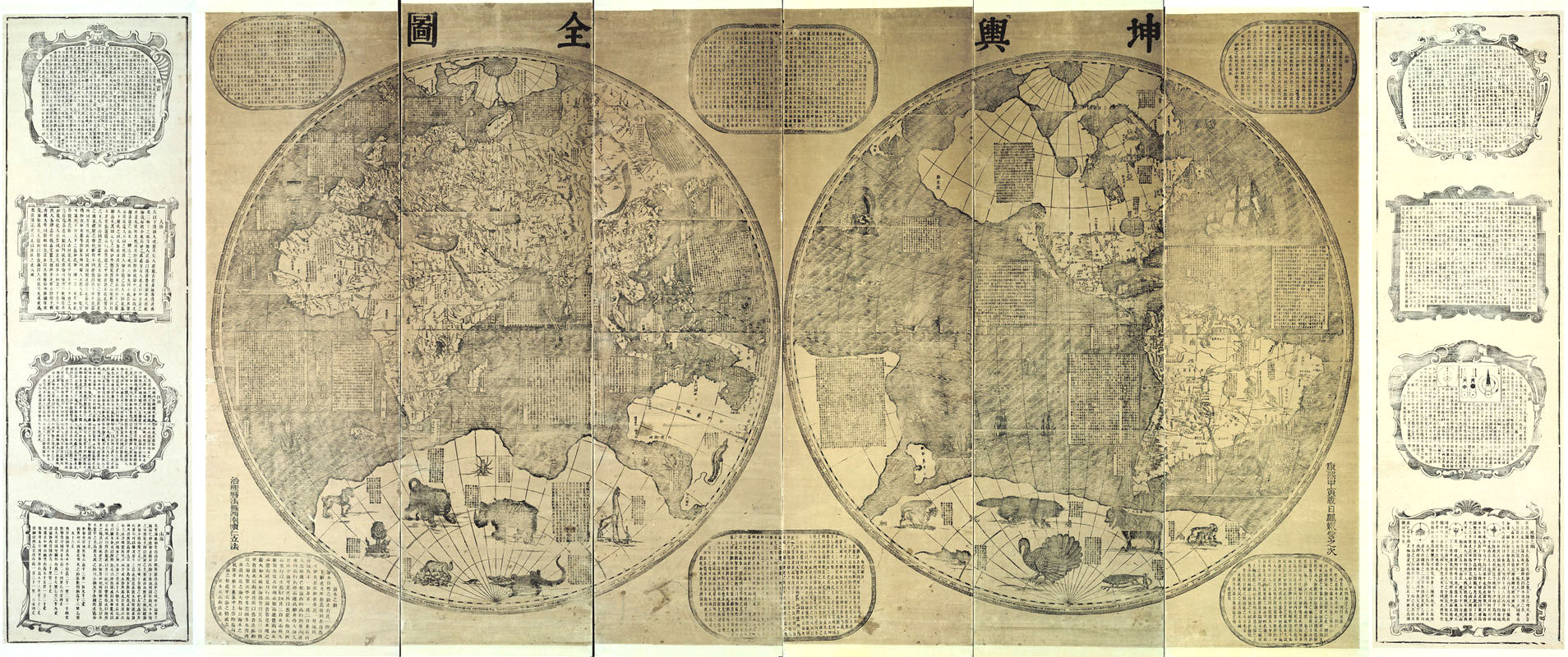
The world map was quite marvelous. Besides the map itself, Verbiest included all sorts of secondary details to enhance the appearance or usefulness. The entire map bears signs of diligent craftsmanship from the oceans of carefully crafted waves to the intricate illustrations of animals. (3) Verbiest included a variety of fantastic animals, from the mighty unicorn to the humble beaver. (3) Each animal featured a short encyclopedic entry next to it. In fact, nearly all of the map was filled with annotations of one kind of another. Verbiest placed fourteen major essays around the exterior of the map to explain various high-level concepts including astronomy, humanity and morals, the ‘four’ elements, earthquakes. (3)
Verbiest also included whatever details he knew of the countries around the world and the inhabitants therein. (3) While there are some incorrect details, such as the cause of earthquakes, the inclusion of unicorns as real animals, and the portrayal of California as an island, the scale of the map is incredible. The entire map is filled with annotations in Chinese and Antarctica in particular is sprinkled with animal images and descriptions. (3)
Verbiest had converted many respected people including mandarins, princes, and scholars. Between his work and the other Jesuit missionaries, there were 800,000 Catholics in China when he died. (1)

An Armillary Sphere in Action (8)
- Fr. Ferdinand Verbiest, S. J. (1623-1688) a Jesuit scientist in China http://www.faculty.fairfield.edu/jmac/sj/scientists/verbiest.htm
- Ferdinand Verbiest http://ricci.bc.edu/people/ferdinand-verbiest.html
- A Complete Map of the World, 1674 http://verbiest.asianart.org
- Ferdinand Verbiest http://www.newadvent.org/cathen/15346a.htm
- Verbiest Map https://www.gla.ac.uk/hunterian/collections/collectionsummaries/archaeologyandworldcultures/worldcultures/verbiestmap/
- Matteo Ricci World Map http://www.myoldmaps.com/renaissance-maps-1490-1800/441-ricci.pdf
- Ferdinand Verbiest [sic] (1562-1633) http://hua.umf.maine.edu/China/astronomy/tianpage/0029Verbiest9284crw.html
- Armillary Sphere animation https://www.youtube.com/watch?v=M0chCdFEaP0
- The First Automobile of Any Type Was Built By This Flemish Priest In China https://jalopnik.com/the-first-automobile-of-any-type-was-built-by-this-flem-452218957
- Ferdinand Verbiest: Early Visionary of Auto-motion http://www.autoviva.com/news/ferdinand_verbiest_early_visionary_of_auto_motion/575