Father Eugene Lafont started the science front in India, with his amazing presentations on new inventions, and with assisting in the formation of the The Indian Association for the Cultivation of Science. He used his observatory to predict a cyclone and save many lives, as well as aiding in the investigation of the rare Transit of Venus.
Eugene Lafont was born in March of 1837, in a southern town in Belgium called “Mons”.(1) His early education was at St. Barbara’s College at Ghent, where his father an army officer was posted.(1) Here he joined the Society of Jesus in December of 1854. After the necessary training of the Order, and being a teacher during 1857-1859 and 1862-1863, he went to Namur College for studying Philosophy and Natural Sciences, where he showed an aptitude for physical examination.(1;2) in 1865 the previous minister of Namur College, Father Deplechin, requested for the services of Father Lafont for teaching physics in the new (made in 1860) St. Xavier’s College in Calcutta(Kolkata), India.(1)
Father Lafont’s first assignment was to teach the 5th year or Pre-entrance class of the school.(1) Because the school was just made it did not have equipment for practical experiments, he fixed this by installing a laboratory, probably the first one in India, and an observatory.(2;3) In 1867 the observatory was able to, with the daily meteorological observations, anticipate a devastating cyclone and prevent the loss of many lives.(2) In the same year when the BA class opened at St. Xavier’s Father Lafont was promoted to take charge of the Natural Philosophy division. He also taught Mental and Moral Philosophy, and when he became comfortable with English (1870) he began to give scientific lectures for the public.(2) He had a gift in popularizing scientific knowledge, and all of the new scientific discoveries and inventions of the second half of the 19th century were made known with an examples of the invention.(2)
In 1871 he became the Rector of St. Xavier’s.(1) Three years later a high level international scientific expedition came to Calcutta on its way to Midnapore, a town to the south-west of Calcutta, to observe a rare astronomical event, the transit of Venus.(1) The leader of the expedition was Pietro Tacchini, the other members were Jesuit Angelo Secchi director of the observatory of collegio Romano, Alessandro Dorna of the observatory of Turin, Antonio Abetti of the observatory of Padua.(1) At the insistence of Father Lamouroux, Italian consul of Calcutta, and Lafont (who had been consulted), they went to the region now called West Bengal.(1) Lafont was invited to join the expedition, and he went with Prof. Dorna and carried out visual observations.(1) The spectroscopic observations were carried out by Prof. Tacchini and Abetti.(1) Weather hindered the observations, but they were still able to obtain important results.
Tacchini realized that having an observatory in India would work well because it’s warm climate would mean that they could be observing the stars even in the winter, as observatories do not work then.(1)Tacchini convinced Lafont to make an observatory in India at St. Xavier’s, and when the creation of the spectroscopic observatory in Calcutta was announced, the observatory was given grants by the government, and from the people. In 1875 Lafont wrote to Tacchini saying that the observatory would be complete in 18 months.(1) The observatory was the biggest housed on an educational campus. (3)
The Indian Association for the Cultivation of Science was established in 1876 with financial aid from Mahendra Lal Sircar.(2) It’s purpose was “to enable the Natives of India to cultivate Science in all its departments with a view to its advancement by original research, and (as it will necessarily follow) with a view to its varied applications to the arts and comforts of life.”(1) It was proposed to create mass interest in science and for the training of scientists for original research. (1) It was working in this institution that C. V. Raman brought the Nobel Science Prize to India.(1) Father Lafont lent his support to this idea, and also helped the Association develop in many ways.(1) The provisional committee that drew up a plan for the association was chaired by Lafont, and when the university began Lafont and Dr Sircar were honorary lecturers in Physics, with Dr. Kanai Lal Dey being an honorary lecturer in Chemistry.(1) Father Lafont gave on average 20-30 lectures a year, but his oratory skills were proverbial, with his lectures containing experimental demonstrations.(1)
Father Lafont was the teacher of the first modern scientist in India Jagadis Chandra Bose.(1) It was Father Lafont that inspired him in experimental science.(1) Bose thought very well of Father Lafont with his patient skill, and brilliance of experimentation, and Lafont thought likewise of Bose calling him “one of the best students we had in our College Department.”(1) Father Lafont believed that Bose had priority over Marconi in inventing the wireless telegraph, asking for his assistance in his presentation on the his public lecture “Telegraphy Without Wires”(1)
He continued to give regular lectures until 1893, when he continued to give popular science lectures at the association, but less often, but he still he participated in the annual meetings.(1) His last lectures was in 1903, and on the 30th annual general body meeting he supported the idea that the Association should move away from teaching, and concentrate original research.(1)
Works Cited
Lafont Father Eugene http://vigyanprasar.gov.in/lafont-father-eugene/
Eugène Lafont http://enacademic.com/dic.nsf/enwiki/7760958
150-year-old St Xavier's College's observatory restored https://timesofindia.indiatimes.com/city/kolkata/150-year-old-St-Xaviers-Colleges-observatory-restored/articleshow/31811293.cms
Showing posts with label mathematics. Show all posts
Showing posts with label mathematics. Show all posts
Saturday, August 11, 2018

Friday, August 10, 2018
Eugenio Barsanti
Italy (1821-1864)
Priest, Physicist, and Mathematician.
Eugenio Barsanti was born in 1821. After he’d gotten old enough to talk, walk, and make decisions about his own education, he joined the convent of Sant’ Agostino in Pretsanta to study at the convent’s scientific school. He obtained “higher studies with excellent results in all subjects, … [particularly]... scientific subjects,” (1) and went on to be ordained a priest. After his novitiate, Fr. Barsanti decided to attend San Giovannino college. At some point, he was even a Professor of physics in the college of S. Giovannino.
He also taught physics and mathematics in Volterra at the college of San Michele. There, Fr. Barsanti developed a way “to use the bursting of air and gas to produce a new driving force.” He did this using “a reproduction of Alessandro Volta’s gun” which he built himself. He then filled it with hydrogen and air, and hermetically sealed it using a cork cap and a brass bar. The electrologopneumatic gun burst the seal, sending it flying toward the ceiling. This was a classroom demonstration.
After some time in Volterra, Fr. Barsanti continued “his experiments in physics at the Ximeniano Observatory in Florence … where he … had the opportunity to meet Felice Matteucci.” Felice Matteucci was also from Lucca, Italy and was working on reclamation of the Bientina lake. Barsanti was a physicist, Matteucci an engineer, and they worked well together.
The two worked together on creating an internal combustion engine. “Research and experiments [began in 1851]... with a cast-iron cylinder with a piston and valves, through which they studied the effects of some explosive mixtures.” (2) Once Barsanti and Matteucci created a prototype, they decided to patent their invention. “They applied for authorship in England, at the time the leading European country in the field of trade and industry.” (2) They also filed patents in 1853 in France, Germany, and Italy.In 1854, they got their patent from England. They finished building the engine in 1860. They also set up a company around the invention, an engine which featured a two-cylinder engine, twenty horsepower. However, while the invention was brilliant in scientific terms and useful in economic ones (the force of a steam engine cost 12 cents, while their invention produced a force at 2 cents)(2), non-Italian countries initially stuck with a later, similar invention created by Etienne Lenoir and patented in 1859. In fact, for several decades no one discussed Barsanti and Matteucci’s invention at all, instead beginning the history of internal combustion engines with Lenoir’s invention. (3)
Nonetheless, Matteucci and Fr. Barsanti continued their collaboration and created new prototypes of their engine. Then, in 1864, John Cockeril’s mining company in Belgium “decided to use [Father] Barsanti’s engine for a first series production, [as the new prototype was] much more efficient than Lenoir’s engine.” (1)
Fr. Barsanti’s life was filled with study, physical experimentation, and ecclesiastical duty. He died at age 43, 1864 of typhoid fever, shortly before he was intended to participate “in the start of series construction of his engine” (1)
Works Referenced
Francesco Maurolico
Sicily (1494–1575)

Francesco Maurolico was born in 1494, and twenty-seven years later, in 1521, he was ordained a priest. At this point, Francesco was the eldest surviving son. This meant that when his father died, Maurolico received the inheritance, which allowed him to “concentrate on his scholarly pursuits [...] and [produce] significant contributions in a broad range of different topics, although his best work was done on mathematics.” (1)
However, Maurolico was not wealthy; at times he was only able to publish works thanks to support from patrons, who were often leading men in Messina. (1)
In 1532, he completed a translation and rearrangement of "part of Euclid's Elements,” although it wasn’t published until fifty-three years later, with the posthumous release of "Opuscula Mathematica” in 1575. The book also contained seven of Maurolico’s treatises, including De instrumentis astronomicis “on the theory and use of the principal astronomical instruments.” (1)
In 1535, Maurolico wrote Cosmographia. In this book, he provided "methods for measuring the Earth … which were later used by Jean Picard in measuring the meridian in 1670.” (1)
Maurolico also wrote important books on Greek Mathematics, restored ancient works, and translated many ancient texts. This was no easy task given that the only surviving pieces of the work often covered only a couple chapters of information. Even without the discoveries that he made on his own, this is a clear demonstration of his intelligence and expertise. In one case, “Maurolico completed a restoration of books V and VI of Apollonius's Conics in 1547 working from the scant details that Apollonius gives in the Preface to the work. [The books] were not published until 1654, about 80 years after his death, as Emendatio et restitutio conicorum Apollonii Pergaei. Both Guglielmo Libri and Gino Loria claimed that this achievement alone showed that Maurolico was a genius.” (1) At the very least, it showed that he was good at convincing his readers that he knew what Apollonius was thinking.
In 1550, Maurolico became a Benedictine. (1) At the time, the Benedictine order was “one of ... two main monastic orders which formed the basis of Christian life in Sicily.” His life as a Benedictine didn’t bring an end to his writing. In fact, from 1552 to 1554, the Senate of Messina paid him to write the history of Sicily and on mathematics texts.” (1) The history was “published under the title Sicanicarum reum compendium in 1562.” (1)
Additionally, in 1558, Maurolico wrote the Theodosii Sphaericorum Elementorum Libri iii, which included 9 separate works by Maurolico himself, translations and commentaries on other works, a table of secants which included a couple original proofs, and a book that he wrote called De Sphaera Sermo.
Then in 1569, Maurolico became a math professor at the Jesuit college in Messina; among the requirements in his contract was the obligation to teach music theory from the angle of mathematics. (1)
Maurolico later became an abbot in Messina.
[Edited for clarity June 30, 2022]
Works Referenced
(2) https://www.encyclopedia.com/science/encyclopedias-almanacs-transcripts-and-maps/francesco-maurolico
Giovanni Battista Venturi
Italy (1746-1822)

Giovanni Battista Venturi is an Italian scientist born in 1746. Venturi was "fascinated by the history of science as [.. well as] by its application," and was "one of the first to call attention to Leonardo Da Vinci's ‘work as a scientist and engineer" (2). He was also the first to note the effects of constricted channels on fluid flow (1).
Giovanni Venturi's primary expertise was in fluid dynamics and hydraulic engineering. He built on “the work performed by David Bernoulli and Leonard Euler”(2). Venturi discovered that when fluid goes into a constricted area of a pipe, the fluid’s velocity increases and its static pressure decreases. If the velocity stayed constant, rather than increasing, then weird things would happen to the matter present in the pipe, breaking the law of the conservation of matter. Meanwhile, if the pressure stayed constant, rather than decreasing, then the kinetic energy produced by the velocity would not follow the law of conservation of energy, again causing physics problems.
By 1769, 23-year-old Giovanni Venturi was ordained and became a professor. In 1774, he was appointed as professor of geometry and philosophy at the University of Modena. (2) In 1778, he was promoted to Professor of experimental physics. During his tenure, he was also the state engineer and state auditor for the Duke of Modena, as well as ducal mathematician. He “served in many diplomatic appointments on France & Switzerland” and met with fellow scientists there. He retired in 1813, “but continued to publish his own works and compile works of other famous scientists until his death in 1822.” (2)
The Venturi effect is something we use to this day. For example, a Venturi nozzle can generate a velocity high enough and a pressure low enough to draw a vacuum.
[Edited June 30 2022 for clarity]
Works Referenced
(1) Bernoulli's Theorem https://www.britannica.com/science/Bernoullis-theorem#ref254081
Andreas Tacquet
Belgium (1612–1660)

Andreas Tacquet went to a Jesuit college for his higher education and joined the Jesuit order in 1629. The same year, he began studying at Malines, Belgium. Then, partway through 1631, he went to Louvain and continued his studies. He studied mathematics under William Boalmans, who had been taught by Gregorius Saint Vincent (1). He also studied logic and physics.
From 1634 to 1639, Tacquet taught at Jesuit colleges, and then from 1640 to 1644, he studied theology at Louvean. This was followed by a year or so of teaching math at Louvean. Then, in November 1646, he took his vows and continued to teach math (1).
He published several works, and was known for "great clarity" in his writing (3). His works included Cylindrieorum et annularium, which has some original theorems on cylinders and rings; Elementara geometriae, a well organized paraphrase of parts of Euclid and Archimedes; and a posthumously published work called Opera mathematica (1). The final book, published in 1669, was described by Henry Oldenburg as ‘one of the best books ever written in Mathematics (2), and "contained works on astronomy, spherical trigonometry, practical geometry, and fortification” (3).
Tacquet helped to pave the way for Calculus. Previously people had thought of lines as being composed of points. He introduced the idea that a moving point could generate a line -- or a curve. This, and other ideas, influenced the thinking of Pascal and his contemporaries, and acted as a foundation for future progress (3).
Tacquet was a “brilliant mathematician of international repute.” His books were frequently reprinted and there were several Italian and English editions (1, 2). The Elementara geometriae was one of several math textbooks that he wrote for students in his math class. (3).
Works Referenced
Edited for clarity on August 12th, 2021
Monday, June 25, 2018
Matteo Ricci
Italy 1552-1610

Matteo Ricci was born Oct 6, 1552, in Italy. Ricci was an early missionary to China, when China did not look favorably on foreigners. However, by adopting their customs and knowledge of mathematics and astronomy he was able to preach about the Catholic faith.
In 1571, Ricci entered the Society of Jesus, more commonly known as Jesuits. Ricci studied Philosophy, Theology, and learned from mathematics, cosmology and astronomy directly from Father Christopher Clavius. (1) In 1577, Ricci asked to be sent to the farthest reaches of Asia, and by March of the next year he had left for Goa. In 1580 Ricci was ordained, and by 1582 he was sent to Macau to prepare to enter China. (3) At Macau, Ricci spent a year of studying Mandarin and Chinese customs, and then was finally admitted to China.
In the sixteenth century the communities founded by the Nestorian missionaries in the seventh century and the monks in the thirteenth and fourteenth centuries where no longer there, and the new missionaries had to deal with the Chinese suspicion of foreigners. (1) After the death of Saint Francis Xavier, in 1552, there were many fruitless attempts at missionary work, so around 1578 the method was changed. (1)
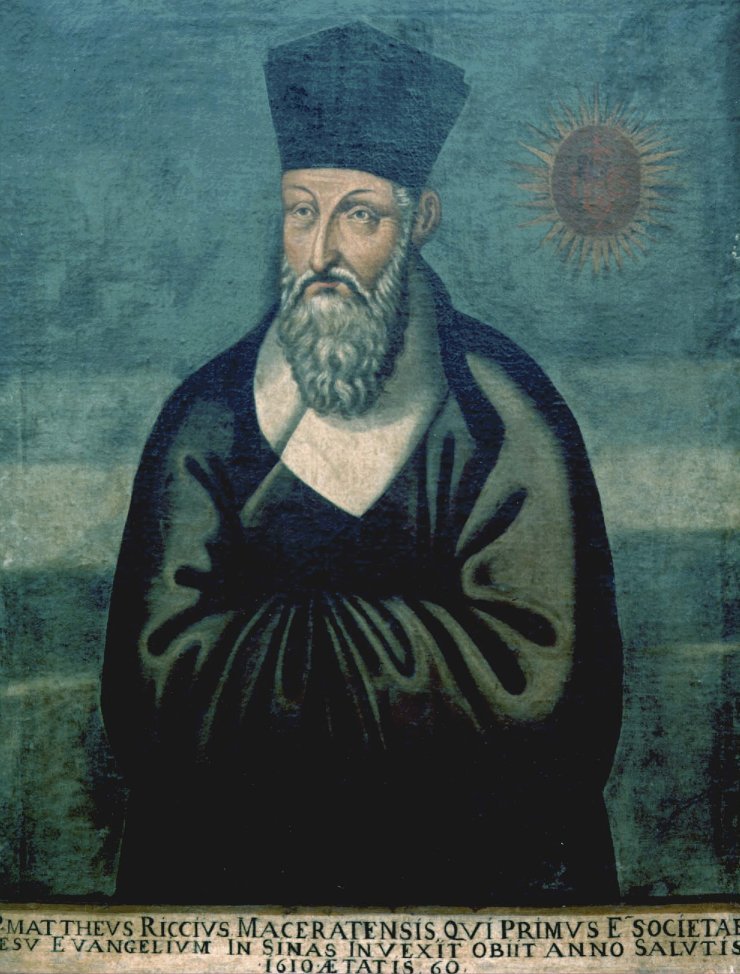 Instead of trying to push western customs, and Latin in religious rites, the missionaries had to learn Mandarin (the main Chinese language), and the customs of the Chinese, this was to adapt to the Chinese, get accepted into China, and stay there as to complete their missionary work. (3) Even though the missionaries were adapting to Chinese custom, there did not hid that they were Catholics or that they were priests. (1) The missionaries placed a pictures of the Virgin Mary holding the Infant Jesus in their homes to start conversations of Catholicism, and they brought many new items to the Chinese, such as clocks, paintings and maps that the Chinese had not seen, to appeal to the curiosity of the Chinese and show them the missionaries had interesting things to teach. (1)
Ricci settled in Zhaoqing (then a major city in Guangdong province). Rather than immediately trying to preach about Catholicism, he tried to win the hearts of the Chinese by continuing to learn their customs and living a good life. (3) Despite his initial caution in preaching Catholicism, he took the risk of publishing the first Catholic Catechism in Chinese, and made the first map of the world “Great Map of Ten Thousand Countries”, which showed China in relation to the rest of the world. (3)
 This was quite a new concept for the Chinese because their maps only featured a few European countries, and these cities were depicted as though they were extremely small compared to the grand Chinese achievements, groveling in the sea around China. (1) Naturally the Chinese were skeptical of the map, and how small a part China seemed to be. Over time, the missionaries were able to explain the process by which it was made and the attention to detail within it, and eventually, the Chinese accepted the map and had more printed in Chinese. (1) The map was an important perception shift for the Chinese as it showed they were not the center of the world and showed how the missionaries (and the rest of the world) had greater learning than the Chinese had supposed. Because of this the Chinese decided that the learning of these missionaries must not be ignored. (1)
In 1589, Ricci travelled from Zhaoqing to Shaozhou (now Shaoguan). In Shazhou Ricci befriended a Confucian scholar, Qu Taisu, and Ricci taught Taisu the rudiments of Mathematics. In return, Taisu introduced Ricci to the upper class mandarin (high military or civil officials). (3) Taisu noted that Ricci’s habit looked similar to a buddhist monk, and suggested that he dress like the Chinese scholar instead. Ricci took the advice when he left Guangdong.
Ricci tried to enter the imperial city of Beijing in 1595, but because of the Sino-Japanese conflict in Korea all foreigners were considered suspect. (3) He left Beijing and traveled to Nanchang and then Nanjing. (3) During his stay at Nanchang, 1595 to 1598, he met two princes, and wrote his first book On Friendship. (3) In 1599, he moved to Nanjing and taught astronomy and geography. (3) In his book, History of the Introduction of Christianity in China, he commented on the effects of his work: The priests had great success teaching the Chinese of geography and astronomy because of their clear explanations.
The Jesuits were highly esteemed.The Chinese did not dare describe them as barbarian, though they would have called foreigners barbaric without a second thought. (3) Encouraged by the reception at Nanjing, Ricci once again to enter Beijing, and in 1601 he was finally admitted, accompanied by a Spanish Jesuit, Diego Pantoja. (3) From then on he never left Beijing, and dedicated the rest of his life to the Chinese people, teaching them science and preaching the gospel. (3)
 His efforts to attract the Chinese intelligentsia lead him in contact with many outstanding personalities, including Li Zhizao, Xu Guangqi, and Yang Tingyun who became known as the Three Pillars of the Early Catholic Church in China. (3) By the time Ricci died, he had converted 2,500 Chinese, many of whom were in the upper classes. (2) Feng Yingjing, a friend of Ricci’s, remarked that “[Ricci] treated the affairs of our fathers as if they were his own and our fathers in turn treated his as if they were ours.” (3) This attitude wonderfully sums up Ricci’s work in China. During Ricci’s time in Beijing he wrote several books in Chinese: The Secure Treatise on God (1603), The Twenty-five Words (1605), The First Six Books of Euclid (1607), and The Ten Paradoxes (1608).
Works Referenced
- Matteo Ricci http://www.newadvent.org/cathen/13034a.htm
- Matteo Ricci, SJ (1552-1610) https://www.ignatianspirituality.com/ignatian-voices/16th-and-17th-century-ignatian-voices/matteo-ricci-sj
- Matteo Ricci https://www.britannica.com/biography/Matteo-Ricci
Further Reading
Wednesday, June 20, 2018
Roger Joseph Boscovich
Croatia 1711-1787

Various versions of his name exist including the English, Roger Joseph Boscovich; the Italian, Ruggero Giuseppe Boscovich; and finally, in his native Croatian: Ruđer Josip Bošković. Boscovich was a Croatian Jesuit mathematician and atomic theorist, though his work and research touched on a plethora of fields. He was born in 1711 in Croatia, but could also be considered an Italian due to the sheer amount of time he spent in Italy. (2) Boscovich decided to attend the Jesuit College in Rome, the Collegium Romanum, and set off in 1725. (2) After a two year stint studying at the Church Sant'andrea delle Fratte, he began his studies at the Collegium Romanum, the premier Jesuit university of the time. (2, 3)
 He finished his initial course in 1732, but needed to teach for five years as the next phase of training. (2) His amazing results as a student earned him a position at the Collegium Romanum. At the same time he began to study the work of Newton and started making astronomical observations. (2) His schedule was quite ambitious, too ambitious as it turned out. His health suffered from this schedule on multiple occasions. Nevertheless, he continued to work. He observed the transit of Mercury in 1736, and then next year published his findings on Mercury, his research on spherical and finished his second phase of study. (2) From here, he commenced theological study that would culminate in his ordination.
In 1740, he became a professor of mathematics at the College, but a couple of years later the Pope, Benedict XIV summoned him, and two other outstanding mathematicians to fix the dome of St. Peter’s Cathedral, which was starting to crack. (3) Boscovich surveyed the site with the others, but was forced to rely heavily on theoretical mathematics to come to their conclusion. (5) They decided the dome was insufficiently supported and required more iron support rings. (5) Had their calculations been entirely correct however, the dome could never have stood for any length of time. Furthermore, their solution was generally distrusted because of the reliance on mathematics, which was seen as unnecessary at the time. Nevertheless, the solution was effective and demonstrated Boscovich’s reliance on mathematics rather than conjecture. (5) In 1744 he was finally ordained.
Boscovich continued his work unrelentingly, publishing more than 70 papers on a variety of scientific topics including optics, gravitation, trigonometry, and astronomy. (2) He created a method to determine a planet’s orbit from three observations, and to calculate a planet’s equator based on three observations of a feature on the surface. (2)
But his work was not limited to research and theory. In 1752, he was once again called on to assist the Pope. On this occasion, he worked with Christopher Maire, an English Jesuit, to survey the boundaries of the Papal States and created the first accurate map of the territory. (3) The survey was conducted directly north from Rome to Rimini and Boscovich used triangulation in order to create their map. They eventually published the map and the details of their expedition in 1755 and titled it ‘On the Scientific Expedition Through the Papal States.’ (9) The map was widely reproduced and is another demonstration of Boscovich’s ability to apply mathematics to real world problems. (9)
One of the challenges Boscovich faced at this point was widespread political dislike for the Jesuit order. Boscovich resolutely set out to use his considerable influence to save the order. He journeyed to Paris in 1759. Boscovich had a magnificent reputation there, for a variety of reasons. He had met two of the members of the Academy of Science while they were travelling through Italy. In 1752, Boscovich sent an account of his research on Saturn and Jupiter to the Grand Prix of the Academy of Sciences. Euler won, but at least Boscovich received an honourable mention. (2) Finally, his work in the surveying the Papal lands, astronomy, and the aurora borealis cemented his reputation as a renowned scientist. (2) At some point he became a member of the Academy of Science. (1) Boscovich’s reputation was such that he was able to convince Benedict XIV to remove Copernicus’ work from the the Index of Forbidden Books. (1)
After a few months in Paris, he set off for England and became a member of the Royal Society. Because of his extended absence, his job was given to another Jesuit, leaving him free to carry on, and with little reason to remain in any particular location. (6) Boscovich was determined to create as many contacts as possible, and travelled across Europe. (6) He returned to Rome in 1763, but not to the Jesuit College. Instead, he worked to drain the Pontine Marshes, and regulate the flow of the Tiber river. (7) Malaria was a pressing issue, partially addressed by the Jesuit introduction of quinine during the 1500s, but marshland still posed a significant health hazard.
However, the threat to the Jesuits loomed ever larger. The Jesuit suppression occurred for a variety of reasons, but in large part because of the Jesuit reduction settlements. (4) These settlements had helped the natives achieve a better standard of life and when the Portuguese attempted to expand and force the natives out, the natives decided to defend themselves. Jesuits specifically had stepped aside, but were blamed for inciting a war against monarchy anyway, and then the order was banned in Portugal in 1759, with France and Spain following in a few years. (4)
The French attacked the Jesuits because they were unable to repay loans taken out to build sugar plantations, despite king Louis XV attempts to protect them. (4) These events forced astronomical change on Boscovich. He had been invited to journey to Baja California to observe the transit of Venus, quite a rare event, many occur hundreds of years apart; only eighty-one occured over a six-thousand year period. Occasionally though, transits occur eight years apart, a double transit of sorts. (8) Boscovich was fortunate enough to have the opportunity to live during one of these eight year cycles. However, the first available transit, in 1761, saw Boscovich in Venice under a cloud-ridden sky, while he was attempting to make his way to Constantinople. (3) This second chance in 1769 offered him the opportunity to make up for having missed the previous chance, though it would be the last in his lifetime. However, the situation was too dire for the Jesuit order and so Boscovich declined the trip. Many of the astronomers died of disease on that trip, so it was probably just as well that he avoided it. (3)
The French monarch was willing to keep current Jesuits, but the courts had ruled no against the Jesuits novices could be taken on. (4) The Jesuit colleges were shut down, but their alleged riches were nowhere to be found. Various other European powers started exiling the Jesuits and pressuring the Pope to suppress the order. (4) Pope Clement XIII was unwilling to suppress the order of which he thought so highly, but with his death, a cardinal willing to suppress the order became Pope Clement XIV. Even then, Pope Clement XIV tried to appeal, pointing to the fact that Austria-Hungary’s ruler opposed the suppression of the order. However, Austria-Hungary wanted an alliance with another power and was willing to go along with the suppression to expedite their plans. Therefore in 1773, Pope Clement XIV finally had to give the order for the Jesuits to be suppressed. (4)
When the news of the Jesuit order’s suppression came to Boscovich and he decided to head back to his native Croatia when he was invited to Paris by King Louis XVI. (6) Boscovich received a significant salary, 8,000 and the ability to work with the French Navy (6, 7) One of his key projects while working for the French Navy was developing an achromatic telescope. An achromatic lens is a lens that does not separate light into its constituent colors, creating a superior image. However, he faced a few issues in France (3) Boscovich had become a French citizen to allay their issues with a foreigner directing the Optics of the French Navy, he’d had to defend his method of determining an orbit from three observations, and also had an issue with who was getting the new equipment he had created. (2) In the end, he stayed long enough to publish a book on eclipses, but ultimately thought it better to leave France in 1782 and return to Italy(4).
Boscovich regularly published on scientific or philosophical ideas, and was also a poet. (6) He improvised verse in public, created poems about scientific subjects, and was part of an Italian society of poetry (6) He wrote several books, as well. Teacher, Engineer, Astronomer, Poet, Mathematician, Physicist, Historian, Diplomat, Jesuit, Priest, Catholic.
However, one would be remiss for failing to mention Boscovich’s most famous work: the Theory of Natural Philosophy, first published in 1758. The volume dealt the nature of atoms, which Boscovich was certain must be tiny points, almost non-existent except for the forces they produced. (1, 6) Boscovich summarizes his theory as follows “Matter is composed of perfectly indivisible, non-extended, discrete points.” (7) Furthermore, he argues no atoms can be in the same place at the same time. He reasoned that in a three dimensional space the number of points is infinite, while there are a finite number of atoms, therefore without anybody manipulating them, atoms are infinitely improbable to be in the same place. (7) In addition, Boscovich finds that atoms can never touch, but the gap between them can be infinitely small. (7) These atoms would have a property essentially like inertia but without mass since any amount of mass in an infinitesimally small point would mean an infinite amount of mass in that singular point. (7) Rather, the inertia of these atoms exists based on the forces they produce. The accelerations they produce by their inherent force can come together when they are in a group which eventually comes together to explain gravity on a macroscale. (7) Boscovich held that atoms must produce both attractive and repellent forces, and the force diminishes with distance. (1) The repulsive forces were active on the extremely microscopic scale, alternating as the scale progressed until settling on attractive forces at the macroscopic level. (2)
Works Referenced
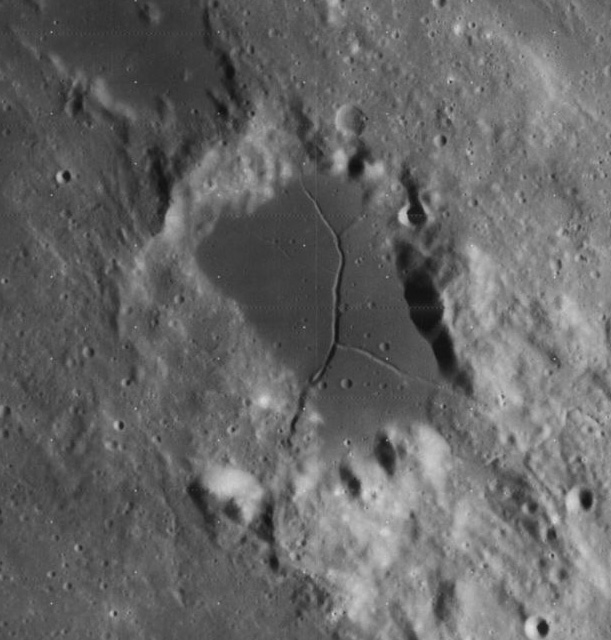
Lunar Crater Named in Boscovich's honor

Various versions of his name exist including the English, Roger Joseph Boscovich; the Italian, Ruggero Giuseppe Boscovich; and finally, in his native Croatian: Ruđer Josip Bošković. Boscovich was a Croatian Jesuit mathematician and atomic theorist, though his work and research touched on a plethora of fields. He was born in 1711 in Croatia, but could also be considered an Italian due to the sheer amount of time he spent in Italy. (2) Boscovich decided to attend the Jesuit College in Rome, the Collegium Romanum, and set off in 1725. (2) After a two year stint studying at the Church Sant'andrea delle Fratte, he began his studies at the Collegium Romanum, the premier Jesuit university of the time. (2, 3)
He finished his initial course in 1732, but needed to teach for five years as the next phase of training. (2) His amazing results as a student earned him a position at the Collegium Romanum. At the same time he began to study the work of Newton and started making astronomical observations. (2) His schedule was quite ambitious, too ambitious as it turned out. His health suffered from this schedule on multiple occasions. Nevertheless, he continued to work. He observed the transit of Mercury in 1736, and then next year published his findings on Mercury, his research on spherical and finished his second phase of study. (2) From here, he commenced theological study that would culminate in his ordination.In 1740, he became a professor of mathematics at the College, but a couple of years later the Pope, Benedict XIV summoned him, and two other outstanding mathematicians to fix the dome of St. Peter’s Cathedral, which was starting to crack. (3) Boscovich surveyed the site with the others, but was forced to rely heavily on theoretical mathematics to come to their conclusion. (5) They decided the dome was insufficiently supported and required more iron support rings. (5) Had their calculations been entirely correct however, the dome could never have stood for any length of time. Furthermore, their solution was generally distrusted because of the reliance on mathematics, which was seen as unnecessary at the time. Nevertheless, the solution was effective and demonstrated Boscovich’s reliance on mathematics rather than conjecture. (5) In 1744 he was finally ordained.
Boscovich continued his work unrelentingly, publishing more than 70 papers on a variety of scientific topics including optics, gravitation, trigonometry, and astronomy. (2) He created a method to determine a planet’s orbit from three observations, and to calculate a planet’s equator based on three observations of a feature on the surface. (2)
But his work was not limited to research and theory. In 1752, he was once again called on to assist the Pope. On this occasion, he worked with Christopher Maire, an English Jesuit, to survey the boundaries of the Papal States and created the first accurate map of the territory. (3) The survey was conducted directly north from Rome to Rimini and Boscovich used triangulation in order to create their map. They eventually published the map and the details of their expedition in 1755 and titled it ‘On the Scientific Expedition Through the Papal States.’ (9) The map was widely reproduced and is another demonstration of Boscovich’s ability to apply mathematics to real world problems. (9)
One of the challenges Boscovich faced at this point was widespread political dislike for the Jesuit order. Boscovich resolutely set out to use his considerable influence to save the order. He journeyed to Paris in 1759. Boscovich had a magnificent reputation there, for a variety of reasons. He had met two of the members of the Academy of Science while they were travelling through Italy. In 1752, Boscovich sent an account of his research on Saturn and Jupiter to the Grand Prix of the Academy of Sciences. Euler won, but at least Boscovich received an honourable mention. (2) Finally, his work in the surveying the Papal lands, astronomy, and the aurora borealis cemented his reputation as a renowned scientist. (2) At some point he became a member of the Academy of Science. (1) Boscovich’s reputation was such that he was able to convince Benedict XIV to remove Copernicus’ work from the the Index of Forbidden Books. (1)
After a few months in Paris, he set off for England and became a member of the Royal Society. Because of his extended absence, his job was given to another Jesuit, leaving him free to carry on, and with little reason to remain in any particular location. (6) Boscovich was determined to create as many contacts as possible, and travelled across Europe. (6) He returned to Rome in 1763, but not to the Jesuit College. Instead, he worked to drain the Pontine Marshes, and regulate the flow of the Tiber river. (7) Malaria was a pressing issue, partially addressed by the Jesuit introduction of quinine during the 1500s, but marshland still posed a significant health hazard.
However, the threat to the Jesuits loomed ever larger. The Jesuit suppression occurred for a variety of reasons, but in large part because of the Jesuit reduction settlements. (4) These settlements had helped the natives achieve a better standard of life and when the Portuguese attempted to expand and force the natives out, the natives decided to defend themselves. Jesuits specifically had stepped aside, but were blamed for inciting a war against monarchy anyway, and then the order was banned in Portugal in 1759, with France and Spain following in a few years. (4)
The French attacked the Jesuits because they were unable to repay loans taken out to build sugar plantations, despite king Louis XV attempts to protect them. (4) These events forced astronomical change on Boscovich. He had been invited to journey to Baja California to observe the transit of Venus, quite a rare event, many occur hundreds of years apart; only eighty-one occured over a six-thousand year period. Occasionally though, transits occur eight years apart, a double transit of sorts. (8) Boscovich was fortunate enough to have the opportunity to live during one of these eight year cycles. However, the first available transit, in 1761, saw Boscovich in Venice under a cloud-ridden sky, while he was attempting to make his way to Constantinople. (3) This second chance in 1769 offered him the opportunity to make up for having missed the previous chance, though it would be the last in his lifetime. However, the situation was too dire for the Jesuit order and so Boscovich declined the trip. Many of the astronomers died of disease on that trip, so it was probably just as well that he avoided it. (3)
The French monarch was willing to keep current Jesuits, but the courts had ruled no against the Jesuits novices could be taken on. (4) The Jesuit colleges were shut down, but their alleged riches were nowhere to be found. Various other European powers started exiling the Jesuits and pressuring the Pope to suppress the order. (4) Pope Clement XIII was unwilling to suppress the order of which he thought so highly, but with his death, a cardinal willing to suppress the order became Pope Clement XIV. Even then, Pope Clement XIV tried to appeal, pointing to the fact that Austria-Hungary’s ruler opposed the suppression of the order. However, Austria-Hungary wanted an alliance with another power and was willing to go along with the suppression to expedite their plans. Therefore in 1773, Pope Clement XIV finally had to give the order for the Jesuits to be suppressed. (4)
When the news of the Jesuit order’s suppression came to Boscovich and he decided to head back to his native Croatia when he was invited to Paris by King Louis XVI. (6) Boscovich received a significant salary, 8,000 and the ability to work with the French Navy (6, 7) One of his key projects while working for the French Navy was developing an achromatic telescope. An achromatic lens is a lens that does not separate light into its constituent colors, creating a superior image. However, he faced a few issues in France (3) Boscovich had become a French citizen to allay their issues with a foreigner directing the Optics of the French Navy, he’d had to defend his method of determining an orbit from three observations, and also had an issue with who was getting the new equipment he had created. (2) In the end, he stayed long enough to publish a book on eclipses, but ultimately thought it better to leave France in 1782 and return to Italy(4).
Boscovich regularly published on scientific or philosophical ideas, and was also a poet. (6) He improvised verse in public, created poems about scientific subjects, and was part of an Italian society of poetry (6) He wrote several books, as well. Teacher, Engineer, Astronomer, Poet, Mathematician, Physicist, Historian, Diplomat, Jesuit, Priest, Catholic.
However, one would be remiss for failing to mention Boscovich’s most famous work: the Theory of Natural Philosophy, first published in 1758. The volume dealt the nature of atoms, which Boscovich was certain must be tiny points, almost non-existent except for the forces they produced. (1, 6) Boscovich summarizes his theory as follows “Matter is composed of perfectly indivisible, non-extended, discrete points.” (7) Furthermore, he argues no atoms can be in the same place at the same time. He reasoned that in a three dimensional space the number of points is infinite, while there are a finite number of atoms, therefore without anybody manipulating them, atoms are infinitely improbable to be in the same place. (7) In addition, Boscovich finds that atoms can never touch, but the gap between them can be infinitely small. (7) These atoms would have a property essentially like inertia but without mass since any amount of mass in an infinitesimally small point would mean an infinite amount of mass in that singular point. (7) Rather, the inertia of these atoms exists based on the forces they produce. The accelerations they produce by their inherent force can come together when they are in a group which eventually comes together to explain gravity on a macroscale. (7) Boscovich held that atoms must produce both attractive and repellent forces, and the force diminishes with distance. (1) The repulsive forces were active on the extremely microscopic scale, alternating as the scale progressed until settling on attractive forces at the macroscopic level. (2)
Works Referenced
- Roger Joseph Boscovich S. J. (1711-1787) http://www.faculty.fairfield.edu/jmac/sj/scientists/boscovich.htm
- Ruggero Giuseppe Boscovich http://www-history.mcs.st-andrews.ac.uk/Biographies/Boscovich.html
- Science in the Enlightenment: An Encyclopedia https://books.google.com/books?id=4H9_Zvp80nAC&pg=PA34&lpg=PA34&dq=Pontine+marshes+boscovich#v=onepage&q=Pontine%20marshes%20boscovich&f=false
- Causes, Process, and consequences of the Jesuit Order’s suppression. https://www.timesofmalta.com/articles/view/20140601/life-features/Causes-process-and-consequences-of-the-Jesuit-Order-s-suppression.521790
- History of Structural Engineering: St. Peter’s Dome http://www.aleckassociates.co.uk/structural-engineering/history-of-structural-engineering-st-peters-rome
- The Jesuit Suppression in Global Context: Causes, Events, and Consequences https://books.google.com/books?id=LUy2CgAAQBAJ&pg=PA265&lpg=#v=onepage&q&f=false
- A Theory of Natural Philosophy https://books.google.com/books?id=RH5jw_7UOT4C&pg=PR7&lpg=PR7&dq=#v=onepage&q&f=false
- Six Millenium of Venus Transits: 2000 BCE to 4000 CE https://eclipse.gsfc.nasa.gov/transit/catalog/VenusCatalog.html
- First Modern Map of the Papal States https://www.researchgate.net/publication/299693061_Exploring_Along_the_Rome_Meridian_Roger_Boscovich_and_the_First_Modern_Map_of_the_Papal_States
Alternate version of source #7
- https://archive.org/details/theoryofnaturalp00boscrich
Lunar Crater Named in Boscovich's honor
Thursday, June 14, 2018
Francesco Lana de Terzi
Italy 1631-1687
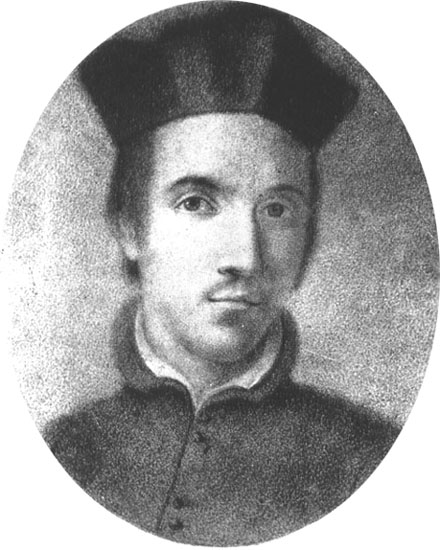
The Italian Jesuit is famous as the Father of Aeronautics because of his idea to create a flying machine based in (nearly completely) sound science. (1) He planned to use spheres of copper, with vacuums inside, to produce the necessary lift, having calculated the necessary size to sustain itself along with passengers. (1) His design is interesting because it used known, functional, technology of the day with strict mathematical calculations and scientific theories to create a successful design. (1, 3)
However, there were a number of considerations that prevented its construction. Lana de Terzi attempted to respond to these in his book, such as the idea that the riders of the flying machine would be flown into space. (1) Lana de Terzi responded that the weight of the ship would prevent the vacuum-filled balloons from reaching outer space, and that onboard valves would reintroduce air to the spheres and provide the capability of successful landing. (1) As for the claim that his balloons would not stand up against atmospheric pressure, he argued the spherical shape would help to withstand the pressure. This idea is flawed, though an interesting attempt.
However, one of the reasons he was wrong on this point was that he never constructed the machine, and this for several reasons.(4) First and foremost, his vow of poverty. (1) Lana de Terzi had calculated there was no way for him to fund the machine on his own, and consequently was forced to rely solely on theory. (1) One of the more existential issues was the threat to all civilization. (1) He feared such airships could be used to lay waste to cities with impudence, raining down destruction with any manner of projectile. When aircraft actually were created, this fear came to fruition within fifty years, so he was correct to consider the threatening possibilities of flight(1)
It is extremely interesting that we consider him the father of Aeronautics despite all of these considerations and limitations. Lastly, it has been alleged that his ideas were essentially just, reused versions of others’ work. (4) But all of this is fails to see the rest of his work.
His idea for a flying machine was published in a book which was entitled -- in part -- ‘Promodero, wise overseer of some new inventions’ ( A link which contains pdf verison photographed in the original Italian is here https://www.e-rara.ch/zut/content/titleinfo/9958403). (1, 3). However, the idea for constructing the balloon airship only took up only one of the chapters of the volume. The previous chapter was dedicated to the idea of flight similar to that of birds, and between them Lana de Terzi distinguished between heavier than air flight and lighter than air flight. (3)
However, outside of those two chapters, the rest of the book was not concerned with flight at all. Instead, the purpose of the book was twofold: To explain the myriad inventions he had theorized and to generate attention for his actual scientific work. (1, 3) One of his ideas was to create a language for the blind, which was actually extremely similar to braille despite preceding Louis Braille by over 150 years. His design was groundbreaking because it relied on a series of dashes to communicate the language rather than attempting to stick directly to the traditional alphabet, as the systems of the time did. Much like his idea for flight, the invention was never actually completed, though it is quite a compelling idea. (5)
The scientific knowledge which Lana de Terzi was publicizing was a planned nine-volume work, named Mastery of Nature and Art, to encapsulate the natural sciences and based in certainty through experiments and geometry. (3) He only managed to publish two, though another was published after his death. (3)
He was also interesting because he was trying to change the accepted ideas of the day in regard to ancient philosophers and magnetism. Lana de Terzi wished to have a variety of sources in use, and compare and contrast them rather than assuming a single source will have all the answers. He argued that science was inhibited by unnecessary fixations on particular sources, such as Aristotle. (2) Lana de Terzi’s attitude was that if Aristotle was wrong, as he was bound to be at some point, one must be willing to learn from some other scientist. (2)
Lana de Terzi was not the only scientist with these claims, but rather represented the new trend of scientists who wished to break with tradition where it did not function. In particular, he was frustrated by the idea that materials’ qualities were part of their ‘nature.’ He remarked annoyedly that if you asked nearly any natural philosopher of his day about anything they would say it was simply “such is the nature of that substance… [why does] a magnet draw iron and not straw, and amber draw straw and not iron?’ They reply this is the nature of amber and that is the nature of the magnet.” (2, pg 17). Altogether a circular argument and therefore unhelpful. Lana de Terzi wanted to break from this tradition by examining the actual causes of the world, hence his attempt at a nine volume collection of science.
It is rather sad then, that we remember him for only his airship. While it relied on a new piece of technology, the vacuum pump, it fails to really show what Lana de Terzi wished to do. (1) It shows that he knew how to predict possible issues with aircraft, but it ignores his desire to revolutionize science. Of all his work, we remember one chapter of the one book he created to generate enough publicity to sell his actual science and this one achievement wasn’t even something that he actually accomplished, nor was it necessarily something he wanted to have happen.
Works Referenced
- Francesco Lana-Terzi, S. J. (1631-1687 The Father of Aeronautics http://www.faculty.fairfield.edu/jmac/sj/scientists/lana.htm
- Elements of Early Modern Physics https://books.google.com/books?id=vBH0vBmG61IC&pg=PA163&dq=Elements+of+Early+Modern+Physics+By+J.+L.+Heilbron+#v=onepage&q=lana&f=false
- Francesco Lana http://www.newadvent.org/cathen/08772c.htm
- The Rational Mechanics of Flexible Or Elastic Bodies https://books.google.com/books?id=gxrzm6y10EwC&printsec=frontcover&source=gbs_ge_summary_r&cad=0#v=onepage&q=francesco%20&f=false
- Foundations of Opthalmology: Great Insights that established the discipline https://books.google.com/books?id=4kszDwAAQBAJ&pg=PA46&lpg=PA46&dq
Wednesday, June 13, 2018
Luca Pacioli
Italy 1445-1517

Luca Pacioli was a Franciscan Friar who taught at the University of Perugia and gained the Chair of Mathematics in 1477. (1) While at Perugia, Pacioli wanted his students to be able to apply the math they were learning, an uncommon tactic at the time. (4) Pacioli became a travelling mathematician in 1480, and arriving in Rome in 1487. The Pope, Sixtus IV, gave him particular privileges, causing friction between Pacioli and other Franciscans when Pacioli attempted to return to teach at his hometown, Sansepolcro. As a result, he was banned from teaching in 1491, though their stance had changed somewhat by 1493, since he was then invited to preach during Lent. (1, 2)
Pacioli wrote his first treatise on mathematics when he was nineteen, and created various other publications throughout his life. (1) His most influential work, published in 1494, was entitled The Collected Knowledge of Arithmetic, Geometry, Proportion, and Proportionality. This work was essentially an all-in one reprint of a variety of master mathematicians. Paicoli had not invented the math, merely repackaged it. (4) Still, it was a start and encouraged mathematical progress over the next decades. (2)
One particular piece of this work was of particular interest due to its effect on the field of accounting, the area which Pacioli is now most famous for.(4) Pacioli started, or at least was the first to record, the double entry bookkeeping system, the use of ledgers, and income statements. (1) The double entry system means a company would note money spent on food, for example, as negative in the general funds section, and positive in the food expense column. As long as the total amount of money doesn’t magically increase, this system helps to provide a clear indication of where money is being spent. (3) Pacioli altered the field of accounting so thoroughly he is now considered the Father of Accounting. (4)
The Collected Knowledge... was widely read and made Pacioli famous. (4) He was invited to Milan around 1496 and there met Leonardo da Vinci. The two became friends and spent the next seven years teaching each other what they knew of art and math. (4) Pacioli had learned from the painter and mathematician Piero della Francesca, an early architect of perspective in art. (2) Pacioli taught Leonardo about perspective which was then aplied in the Last Supper painting. Leonardo provided illustrations for another of Pacioli’s books, The Divine Proportion. (2, 4) The Divine Proportion was concerned with the properties of the Golden Ratio, which Paicili considered so sublime he compared to God. (5) Their friendship is fairly certain, as Da Vinci often mentioned Pacioli in his notes. (4)
Towards the end of his life, Pacioli once more returned to his hometown, and may have become abbot of the monastery there, though his four year stay ended in 1514 as he was summoned to Rome by the Pope. (4) Unfortunately, he died in 1517, before making the journey to Rome. (4) Unlike so many other mathematicians and scientists, Pacioli was actually able become famous within his own lifetime. Quite often, the merits of a scientist’s work is not appreciated until another person duplicates their findings and happens upon the former scientist at some later point. Nor has Pacioli’s work faded into obsolescence: a version of his system is still in use today. (2)
Works Referenced
- Luca Pacioli https://famous-mathematicians.com/luca-pacioli/
- Luca Pacioli http://www-history.mcs.st-andrews.ac.uk/Biographies/Pacioli.html
- What is Double Entry Bookkeeping? https://www.accountingcoach.com/blog/what-is-double-entry-bookkeeping
- Luca Pacioli: The Father of Accounting http://flynf.tripod.com/pacioli.htm
- The Divine Proportion by Luca Pacioli http://www-history.mcs.st-andrews.ac.uk/Extras/Divine_proportion.html
Tuesday, June 12, 2018
Bernard Bolzano
Bohemia (Now roughly the Czech Republic ) 1781-1848

Bernard Bolzano was many things, though principally a philosopher and mathematician. He was born in Bohemia, now the Czech Republic, and spoke and wrote German. He studied mathematics and philosophy at the Charles-Ferdinand University of Prague. Starting in 1800, he studied theology and graduated in 1804 (2). At this point, he had two positions open to him, as a professor of mathematics or a position in science and religion (2). Bolzano chose the science and religion route and was ordained in 1805, achieved his doctorate in philosophy and started working.
However, he got into trouble because of his desire to reform the Austrian Empire. He thought war, and militarism in general, was terrible unnecessary and led a movement to refocus Austria on peace. (3, 4). At the time, most of Austrian society was built around the military and Bolzano wanted Austria's education and society to consider peace instead (3). He created a book on the subject, entitled On the Best State in which he imagined a government dedicated to reducing human suffering and misery as effectively as possible. (1).
As Napoleon was still attempting to conquer Europe at the time, Bolzano's views were taken none too well, and he was investigated for heresy. In 1819 he was drummed out of the university and banned from publication (3). He was eventually able to around the ban by getting some of his contacts and students to publish some of his work (1).
Bolzano achieved a level of insight into a variety of fields, mostly on a logical, mathematical, and philosophical basis. He tended towards existential issues, trying to establish concrete reasoning to get to the heart of the matter. Bolzano wrote in such diverse fields as the aesthetic, the theological, the logical, and the mathematical (1).
Bolzano wrote on the subject of art and beauty, and attempted to scientifically describe beauty. He was not actually successful. He argued that objects were beautiful if they "can give to all human beings properly developed in their cognitive faculties a pleasure, and the reason for this is that... [it] gives them at least an obscure intuition of the proficiency of their cognitive faculties" (1). As with some of his other philosophical work, it gives a definition, that leaves a lot to be desired. For instance, what does ‘proper development’ for cognitive faculties look like? Rather than being objective, his definition ends up being extremely subjective.
As for theology, he wanted a rational and credible lens through which to interpret miracles so he wrote extensively on probability theory in his theological works, trying to establish how to ensure the event had was improbable, that is less than 50% chance of occurring. He was not extremely concerned with the exact probability beyond that, just how to make sure it was sufficiently improbable to be considered a miracle (1).
As for logic, Bolzano imagined three 'Worlds.' The first contains all material things, the second for psychological (and presumably emotional) ideas, and the third only for logical ideas and concepts. Then, he wanted to prove, without assumptions, that true statements existed (1). He created a proof to demonstrate there must exist an infinite number of true statements existed. His proof flowed in a logical, almost mathematical way.
Firstly, he examined the statement that there were no true statements, in and of themselves. Then, he examined the preposition that there are no true statements, found that must itself be a preposition and therefore proving at least one preposition, or statement not based on assumption exists. From there, he continued by plugging in the first result again. If there is one true statement, the statement that there is only one true statement means there is at least one MORE true statement and so on. Hence, an infinite number of true statements exist (1).
Among Bolzano's mathematical feats were creating a better proof for the bionomial theorem, applying probability to limits, and creating the Bolzano-Weierstrauss Principle (3, 5, 6). Of all his work, his mathematical contributions have been the most important.
Works Referenced
- Bernard Bolzano https://plato.stanford.edu/entries/bolzano/
- Bernard Bolzano: Philosophy of Mathematical Knowledge http://www.iep.utm.edu/bol-math/
- Bernhard Bolzano https://www.britannica.com/biography/Bernhard-Bolzano
- Selected Writings on Ethics and Politics https://brill.com/view/title/30750
- The Philosophy of Bernard Bolzano: Logic and Ontology https://www.ontology.co/bolzanob.htm
- The Bolzano-Weierstrauss Property and Compactness http://www.u.arizona.edu/~mwalker/econ519/Econ519LectureNotes/Bolzano-Weierstrass.pdf
Thursday, May 4, 2017
Marin Mersenne
French theologian, philosopher, and mathematician; b. 8 September, 1588, near Oizé (now Department of Sarthe); d. 1 September, 1648 at Paris. Marin
Mersenne was perhaps the most brilliant and the most unknown men of the
16th and 17th centuries. Born of peasant parents near Oizé, Maine
(present day Sarthe, France). He was educated at Le Mans and at the
Jesuit College of La Flèche, where a lifelong friendship with Descartes, his fellow student, originated. On 17 July 1611, he joined the Minim
Friars at Nigeon near Paris and, after studying theology and Hebrew in Paris, was ordained a
priest in 1613. Between
1614 and 1618, he taught theology and philosophy at Nevers, but he
returned to Paris and settled at the Minim convent of L’Annonciade in
1619, where he lived for the rest of his life.
There he studied mathematics and music. By 1626, he held weekly scientific discussions in the convent and met with other kindred spirits such as René Descartes, Étienne Pascal, Pierre Petit, Gilles de Roberval, Thomas Hobbes, and Nicolas-Claude Fabri de Peiresc.
His first publications were theological and polemical studies against Atheism and Scepticism, but later, Mersenne devoted his time almost exclusively to science, making personal experimental researches, and publishing a number of works on mathematical sciences.
His most remarkable personal trait was his ability to maintain close personal friendships with men who genuinely hated each other’s scientific ideas. In 1635 he set up the informal Académie Parisienne (Academia Parisiensis) which had nearly 140 correspondents including astronomers and philosophers as well as mathematicians. His network was the precursor of the of the Royal Society in London, founded in 1660, twelve years after Mersenne’s death and the Parisian Académie des sciences established by Jean-Baptiste Colbert in 1666. The stimulus he gave to other writers in many fields — by posing problems, transmitting objections, supplying information, brokering contacts, prompting publication or indeed organizing it himself — was absolutely invaluable.
His chief merit was the encouragement which he gave to scientists of his time, the interest he took in their work, and the stimulating influence of his suggestions and questions. Gassendi and Galileo were among his friends; but, above all, Mersenne is known today as Descartes's friend and adviser. In fact, when Descartes began to lead a free and dissipated life, it was Mersenne who brought him back to more serious pursuits and directed him toward philosophy. In Paris, Mersenne was Descartes's assiduous correspondent, auxiliary, and representative, as well as his constant defender. The numerous and vehement attacks against the "Meditations" seem, for a moment, to have aroused Mersenne's suspicions; but Descartes's answers to his critics gave him full satisfaction as to his friend's orthodoxy and sincere Christian spirit.
Mersenne’s correspondance network of Europe’s top scientists, put him in communication with Giovanni Doni, Constantijn Huygens, Galileo Galilei, and other scholars in Italy, England and the Dutch Republic. He was a staunch defender of Galileo, assisting him in translations of some of his mechanical works, and spreading his discoveries throughout Europe. He disagreed with the views of skepticism, the idea that the world is completely unknowable. Instead, he asserted that knowledge should freely advance through experiment and observation, frequently chiding scholars for not including accurate experimental data in their paperr, while insisting that hypotheses are, at best, probable explanations. He argued that true physics could only be descriptive and strenuously fought the Rosicrucian ideas of the day.
In mathematics, he discovered what are now known as Mersenne Primes. In astronomy, he discovered the telephoto effect, and was the first to establish both the two-mirror telescope and the afocal telescope, along with the beam compressor that is useful in many multiple-mirror scopes today. He demonstrated how to correct spherical aberration. His work on the pendulum was superior to even Galileo’s.
But, it is his book, L’Harmonie universelle, that is his most influential work. It is one of the earliest comprehensive works on music theory, touching on a wide range of musical concepts, and especially the mathematical relationships involved in music. The work contains the earliest formulation of what has become known as Mersenne’s laws, which describe the frequency of oscillation of a stretched string. For this work, he is known as the Father of Acoustics.
Mersenne's works are: "Quæstiones celeberrimæ in Genesim" (Paris, 1623), against Atheists and Deists; a part only has been published, the rest being still in manuscript, as also a "Commentary on St. Matthew's Gospel"; "L'impiété des déistes et des plus subtils libertins découverte et réfutée par raisons de théologie et de philosophie" (Paris, 1624); "La vérité des sciences contre les sceptiques et les pyrrhoniens" (Paris, 1625); "Questions theólogiques, physiques, morales et mathématiques" (Paris, 1634); "Questions inouïes, ou récréations des savants" (Paris, 1634); Les mécaniques de Galilée" (Paris, 1634), a translation from the Italian; "Harmonie universelle, contenant la théorie et la pratique de la musique" (Paris, 1936-7); "Nouvelles découvertes de Galilée", and "Nouvelles pensées de Galilée sur les mécaniques" (Paris, 1639), both translations; "Cogitata physico-mathematica" (Paris, 1644); "Euclidis elementorum libri, Apollonii Pergæ conica, Sereni de sectione coni, etc." (Paris, 1626), selections and translations of ancient mathematicians, published again later with notes and additions under the title, "Universæ geometriæ mixtæque mathematicæ synopsis" (Paris, 1644).
Mersenne asked that, after his death, an autopsy be made on his body, so as to serve to the last the interests of science.
Giovanni Battista Riccioli
Italian astronomer, b. at Ferrara 17 April, 1598; d. at Bologna 25 June, 1671. He entered the Society of Jesus 6 Oct., 1614. After teaching philosophy and theology for a number of years, chiefly at Parma and Bologna, he devoted himself, at the request of his superiors, entirely to the study of astronomy, which at that time, owing to the discoveries of Kepler and the new theories of Copernicus, was a subject of much discussion. Realizing the many defects of the traditional astronomy inherited from the ancients, he conceived the bold idea of undertaking a reconstruction of the science with a view to bringing it into harmony with contemporary progress. This led to his "Almagestum novum, astronomiam veterem novamque complectens" (2 vols., Bologna, 1651), considered by many the most important literary work of the Jesuits during the seventeenth century.
The author in common with many scholars of the time, notably in Italy, rejected the Copernican theory, and in this work, admittedly of great erudition, gives an elaborate refutation in justification of the Roman Decrees of 1616 and 1633. He praises, however, the genius of Copernicus and readily admits the value of his system as a simple hypothesis. His sincerity in this connexion has been called into question by some, e.g. Wolf, but a study of the work shows beyond doubt that he wrote from conviction and with the desire of making known the truth. Riccioli's project also included a comparison of the unit of length of various nations and a more exact determination of the dimensions of the earth. His topographical measurements occupied him at intervals between 1644 and 1656, but defects of method have rendered his results of but little value.
His most important contribution to astronomy was perhaps his detailed telescopic study of the moon, made in collaboration with P. Grimaldi. The latter's excellent lunar map was inserted in the "Almagestum novum", and the lunar nomenclature they adopted is still in use. He also made observations on Saturn's rings, though it was reserved for Huyghens to determine the true ring-structure. He was an ardent defender of the new Gregorian calendar. Though of delicate health, Riccioli was an indefatigable worker and, in spite of his opposition to the Copernican theory, rendered valuable services to astronomy and also to geography and chronology. His chief works are: "Geographiæ et hydrographiæ reformatæ libri XII" (Bologna, 1661); "Astronomia reformata" (2 vols., Bologna, 1665); "Chronologia reformata" (1669); "Tabula latitudinum et longitudinum" (Vienna, 1689).
Paul of Middelburg
A scientist and bishop, born in 1446 at Middelburg, the ancient capital of the province of Zealand, belonging then to the German Empire, now to Holland; died in Rome, 13 December, 1534. After finishing his studies in Louvain he received a canonry in his native town, of which he was afterwards deprived. The circumstances of this fact are not known, but in his apologetic letter on the celebration of Easter he calls it a usurpation, and shows great bitterness against his country, calling it "barbara Zelandiæ insula", "vervecum patria", "cerdonum regio", etc. He then taught for a while in Louvain, was invited by the Signoria of Venice to take a chair for sciences in Padua (1480), travelled through Italy, became physician to Francesco Maria della Rovere, Duke of Urbino, and friend to Maximilian, Archduke of Austria, afterwards emperor. By the former he was endowed with the Benedictine Abbey St. Christophorus in Castel Durante (1488), and by the latter he was recommended to Alexander VI for the Bishopric of Fossombrone (Moroni, LXXXV, 314). Being nominated to that see, in 1494, he destroyed some of his former publications; first "Giudizio dell' anno 1480", in which he had censured a number of mathematicians; then a "Practica de pravis Constellationibus", and a defence of that work against the nephew of Paul II (1484); and finally an "Invectiva in superstitiosum Vatem". He chose for himself an astronomical coat of arms, and, in 497, enlarged and embellished the episcopal palace. Besides some smaller treatises against usurers and against the superstitious fear of a flood in 1524 (Fossombrone, 1523), he wrote important works on the reform of the Calendar, which procured for him invitations by Julius II and Leo X to the Fifth Lateran Council (1512-1518). His "Epistola ad Universitatem Lovaniensem de Paschate recte observando" (1487) was followed by an "Epistola apologetica" (1488), and finally by his principal work "Paulina, de recta Pasch celebratione" (Fossombrone, 1513). The contents and result of the work are described under the article LILIUS. He died while assisting at the Divine Office in Rome, and was buried in S. Maria dell' Anima. His family name is unknown, but in one place he is called Paolo di Adriano (Moroni, XLIV, 120). Scaliger, who calls him "Omnium sui sæculi mathematicorum . . . facile princeps", was his godson.
Joseph Bayma
Jesuit mathematician and scientist, b. in Piedmont, Italy, 9 November, 1816; d. at Santa Clara, California, U.S.A. 7 February, 1892. He entered the Society of Jesus, 5 February, 1832, and distinguished himself in literature, mathematics, and physics. He was in charge of the episcopal seminary of Bertinoro when the troubles of 1860 forced him and many of his brethren to seek shelter in England. Hitherto he had given no special attention to philosophy, but at Stonyhurst he took it up and taught it for some seven years. His powerful and original mind soon produced three volumes of "Realis Philosophia", which were printed for private circulation. No sooner were they out than he introduced numerous corrections; thus the printed volumes cannot be relied upon as evidence of his mature opinions. In 1868 Father Bayma left for California, where he was Rector of Saint Ignatius' College, San Francisco, for three years, but afterwards resided at Santa Clara, teaching elementary mathematics there until his death. At his death he left behind, in manuscript, an elaborate new edition of the "Realis Philosophia" which never saw the light. His published works are "Molecular Mechanics" (Cambridge, 1866); "The Love of Religious Perfection", originally in Italian, in the style of the "The Imitation of Christ" (published in English, Dublin, 1863); articles in "The Catholic World", XVII-XXI (1873-75), the best printed account of his philosophy; two articles in the "Am. Cath. Q. Rev.", II (1877); and "A Discussion with an Infidel", being a review of Büchner's "Force and Matter" (New York, London, and Leamington, 1901). His elementary works on mathematics, all published in San Francisco, are: "Algebra" (1890), "Geometry" (1895), "Analytical Geometry" (1887), "Plane and Spherical Trigonometry" (1886), "Infinitesimal Calculus" (1889).
Father Bayma took the Venerable Bede for his model, and loved to refer to the old Breviary Lesson, which used to be read in England on St. Bede's day. It ran: "Bede [and Bayma too] was handsome of stature, grave of gait, rich and sonorous of voice, eloquent of speech, noble of countenance, a blend of affability and severity. He was affable to the god and devout, formidable to the proud and negligent. He was always reading, always writing, always teaching, always praying." Only the young men who sat under him could know his fascination as a teacher. To posterity he must be known by his "Molecular Mechanics", a metaphysical and mathematical work treating of the constitution of matter. With Roger Boscovich, Bayma reduces all matter to unextended points, centres of force acting in the inverse square of the distance. Thus acting upon one another, but of course not touching, for Bayma abhorred continuous matter and upheld actio in distans, these points were bound up into molecules, and molecules into bodies. Boscovich made his points, or elements, attractive at molar distances, repulsive at molecular. Bayma divides elements into attractive and repulsive, the former always attracting, the later always repelling; the attractive elements preponderating in the in the nucleus of the molecule, the repulsive in the envelope. The work drew attention at Cambridge, and at Trinity College, Dublin. The author was advised to test his theories by ten years of experiments in chemistry and electricity. Unhappily, this was never done. One of his proofs certainly lies open to grave objection, but Bayma's main theory does not stand or fall with that proposition. The gravest objection against the theory is its alleged failure to account for inertia. Father Bayma ever professed the utmost reverence for St. Thomas. His saying was: "the metaphysics of St. Thomas, with modern physics".
Father Bayma took the Venerable Bede for his model, and loved to refer to the old Breviary Lesson, which used to be read in England on St. Bede's day. It ran: "Bede [and Bayma too] was handsome of stature, grave of gait, rich and sonorous of voice, eloquent of speech, noble of countenance, a blend of affability and severity. He was affable to the god and devout, formidable to the proud and negligent. He was always reading, always writing, always teaching, always praying." Only the young men who sat under him could know his fascination as a teacher. To posterity he must be known by his "Molecular Mechanics", a metaphysical and mathematical work treating of the constitution of matter. With Roger Boscovich, Bayma reduces all matter to unextended points, centres of force acting in the inverse square of the distance. Thus acting upon one another, but of course not touching, for Bayma abhorred continuous matter and upheld actio in distans, these points were bound up into molecules, and molecules into bodies. Boscovich made his points, or elements, attractive at molar distances, repulsive at molecular. Bayma divides elements into attractive and repulsive, the former always attracting, the later always repelling; the attractive elements preponderating in the in the nucleus of the molecule, the repulsive in the envelope. The work drew attention at Cambridge, and at Trinity College, Dublin. The author was advised to test his theories by ten years of experiments in chemistry and electricity. Unhappily, this was never done. One of his proofs certainly lies open to grave objection, but Bayma's main theory does not stand or fall with that proposition. The gravest objection against the theory is its alleged failure to account for inertia. Father Bayma ever professed the utmost reverence for St. Thomas. His saying was: "the metaphysics of St. Thomas, with modern physics".
Subscribe to:
Posts (Atom)