Andreas Tacquet went to a Jesuit college for his higher education and joined the Jesuit order in 1629. The same year, he began studying at Malines, Belgium. Then, partway through 1631, he went to Louvain and continued his studies. He studied mathematics under William Boalmans, who had been taught by Gregorius Saint Vincent (1). He also studied logic and physics.
From 1634 to 1639, Tacquet taught at Jesuit colleges, and then from 1640 to 1644, he studied theology at Louvean. This was followed by a year or so of teaching math at Louvean. Then, in November 1646, he took his vows and continued to teach math(1).
He published several works, and was known for "great clarity" in his writing (3). His works included Cylindrieorum et annularium, which has some original theorems on cylinders and rings; Elementara geometriae, a well organized paraphrase of parts of Euclid and Archimedes; and a posthumously published work called Opera mathematica(1). The final book, published in 1669, was described by Henry Oldenburg as ‘one of the best books ever written in Mathematics (2), and "contained works on astronomy, spherical trigonometry, practical geometry, and fortification” (3).
Tacquet helped to pave the way for Calculus. Previously people had thought of lines as being composed of points. He introduced the idea that a moving point could generate a line -- or a curve. This, and other ideas, influenced the thinking of Pascal and his contemporaries, and acted as a foundation for future progress (3).
Tacquet was a “brilliant mathematician of international repute.” His books were frequently reprinted and there were several Italian and English editions (1, 2). The Elementara geometriae was one of several math textbooks that he wrote for students in his math class. (3).
Ferdinand Verbiest was born in what is now Belgium in 1623 and joined the Jesuit order at age 18. (2) He was ordained in 1655. (10) Originally he wanted to go to South America, but was called to China because of Adam Schall von Bell. (7) He was 35 at the time. After preliminary work in the rural areas, Verbiest was summoned to Beijing to assist Johann Adam Schall von Bell with astronomy. By the time he arrived Beijing, the other Jesuits were imprisoned. Verbiest‘s attempts to free the Jesuits were of no avail and he joined them in the terrible conditions. (1, 7)
However an earthquake struck the wing of the palace where they were to be executed so in 1668 Emperor K’ang Hsi (also known as Kangxi), organized a contest of skill between Verbiest and the Mandarin who had started the persecution. (2, 4, 7) The contest was composed of three parts: to determine the shadow on a sundial on a given day, when a lunar eclipse was to take place, and the location of various planets on a specified date. (2) The losing astronomer was exiled and Verbiest became the President of the Bureau of Mathematics. This new position afforded him an excellent ability to influence the Emperor and the persecution ceased.
Verbiest won both the contest and the favor of the emperor.
He was assigned the board of Mathematics and made a very bold demand; the ‘Perpetual Calendar of the Kangxi Emperor’ must be altered! (7) This was unthinkable. Not only did millions of people use the official calendar, but the emperor himself had approved it! (1) Furthermore, this was no quibbling change, Verbiest wanted to remove an entire month! The officials pleaded with Verbiest to change his futile course of action, but he replied that “It is not within my power to make the heavens to agree with your calendar.” (1)
It was changed.
The emperor liked him and learned whatever Verbiest could teach him. Verbiest translated
six books of Euclid into Manchu, and taught geometry, philosophy and music. The Emperor made Verbiest the highest level of Mandarin, included him on journeys across the Empire and allowed him to preach Christianity. (1) In his efforts to fit in, Verbiest studied Machu and Chinese and took a Chinese name, Nan Huairen. (7)
Being a missionary was Verbiest’s entire purpose for being in China so he leapt at the opportunity and included Christianity whenever he could. (1) Verbiest worked so diligently at his posts because he hoped he could thereby convince the Emperor to become Catholic. (4) Unfortunately this did not occur. Verbiest’s position allowed him much greater influence however, and he was able to reach much farther with his writing and preaching than his fellows as a result. (4) He soon became involved in essentially every project, including the creation of 132 advanced and modern cannon for use by the Imperial Army to stop a rebellion. Verbiest also designed a new type of gun carriage. (1, 4)
Verbiest continued his astronomical work by assembling a table of eclipses, lunar and solar, for the next two thousand years. The emperor was overjoyed with the wondrous progress and promptly made Verbiest in charge of the Imperial Astronomy Observatory. (1)
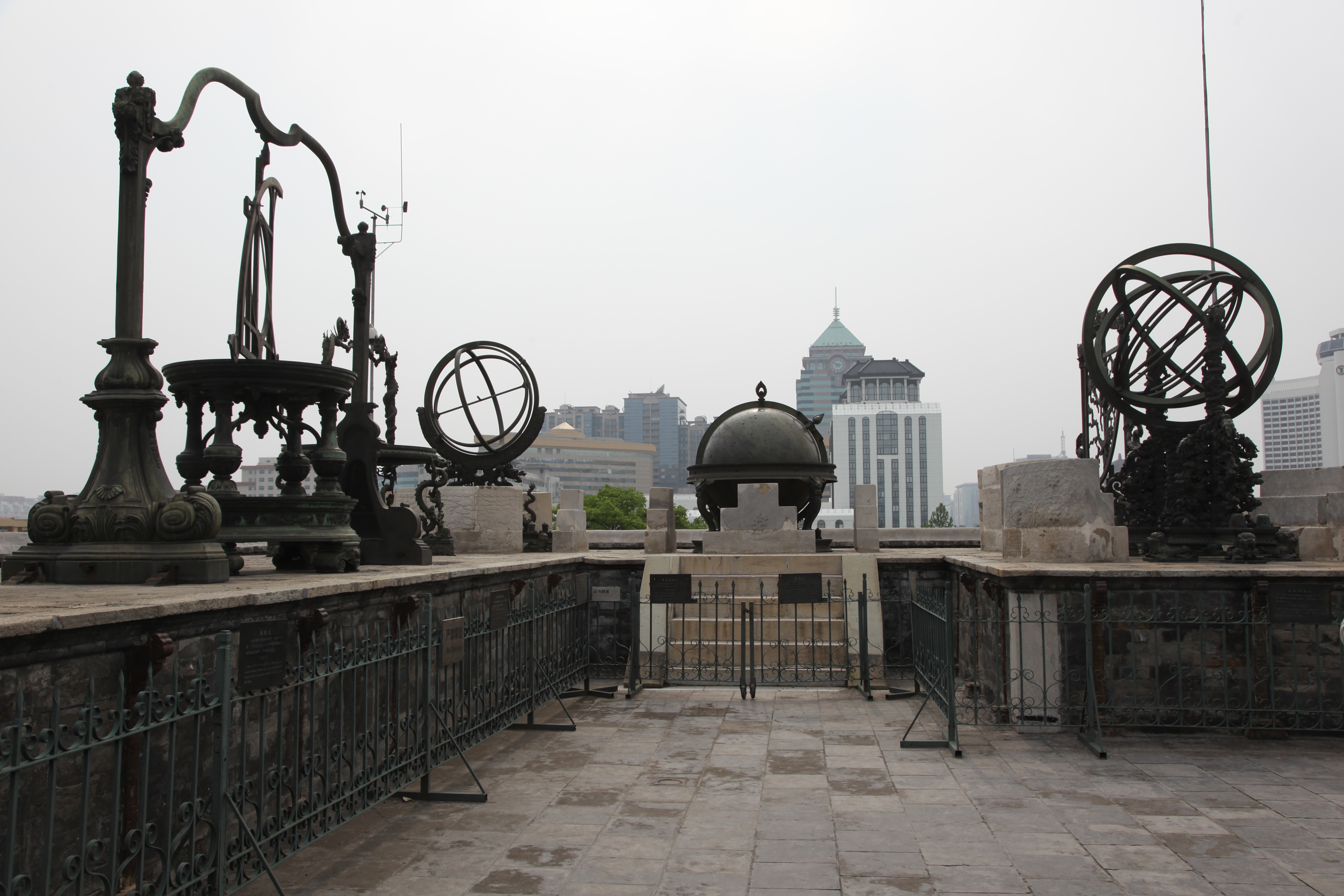
This post was challenging because the structure had been finished in 1279 and so its instruments were extremely… obsolete. Between about 1669 and 1674, Verbiest faced this challenge by assembling a team of master metalworking artisans to make designs imported from Europe. The final instruments were precise enough to measure fifteen seconds, or a nine hundredth of a single degree. (4, 7)
Verbiest documented his work in a 1674 manuscript titled ‘Disclosure on the Newly-Built Astronomical Instruments in the Observatory’ in which he described the design and function of the instruments very precisely so they could be reproduced. It was such detail that for the six instruments he created it took 16 volumes to contain his descriptions. (7)
He created two separate versions of an armillary sphere, an altazimuth, a quadrant, a sextant, celestial globe. These instruments were then put atop the observatory. It may seem rather odd that such a small amount of instruments could take sixteen volumes to describe. (7) One reason for this apparent oddity is the size of the instrumentation. Each was six feet or more in diameter so they were at least the height of a man, and intricately detailed, including multiple dragons per instrument. (4, 7)
Verbiest created a steam engine for ships, designed pumps, built an aqueduct, created numerous maps, and thirty books. His books covered astronomy, Chinese grammar, and he translated a missal into Chinese as well as producing a Chinese book to explain Christianity in simple terms. (1)
Verbiest also designed the first car. It was slightly over two feet long and powered by steam, but the idea of having a self-propelling machine was present. (9) The machine carried a contained or water over a bed of coals and the steam was directed at a turbine which provided the power for it to move. (9) Whether it was actually built is an open question, but the designs were completed.
He was also able to simplify Chinese geometry by reducing the number of degrees in a circle from 365.25 to 360. (7) He was put in charge of public works, assisted China in negotiating their border with Russia, and even sent a missal translated to Chinese to the Pope as evidence of his mission. (2)
The Pope sent him a letter congratulating him for his work, and in 1677 Verbiest was appointed head of all Jesuits in China. (4) He recognized the great opportunities open, but also the desperate need for more priests. He urged missionaries to come from Europe, but also looked to China so that the Chinese could be reached by their own countrymen. (4)
One of the particular needs for Chinese priests was the ability to use Chinese instead of Latin, but Verbiest was not able to obtain this permission. Instead, a few more Jesuits were sent from France. Verbiest used his influence to admit the group to Beijing as swiftly as possible, though he sadly died before they arrived. (4) The emperor delayed the funeral so that the Jesuits could attend and Verbiest was buried next to Ricci and Schall. (1) The emperor was so impressed with Verbiest’s work he bestowed a posthumous name, an honor normally associated with former emperors. (10)
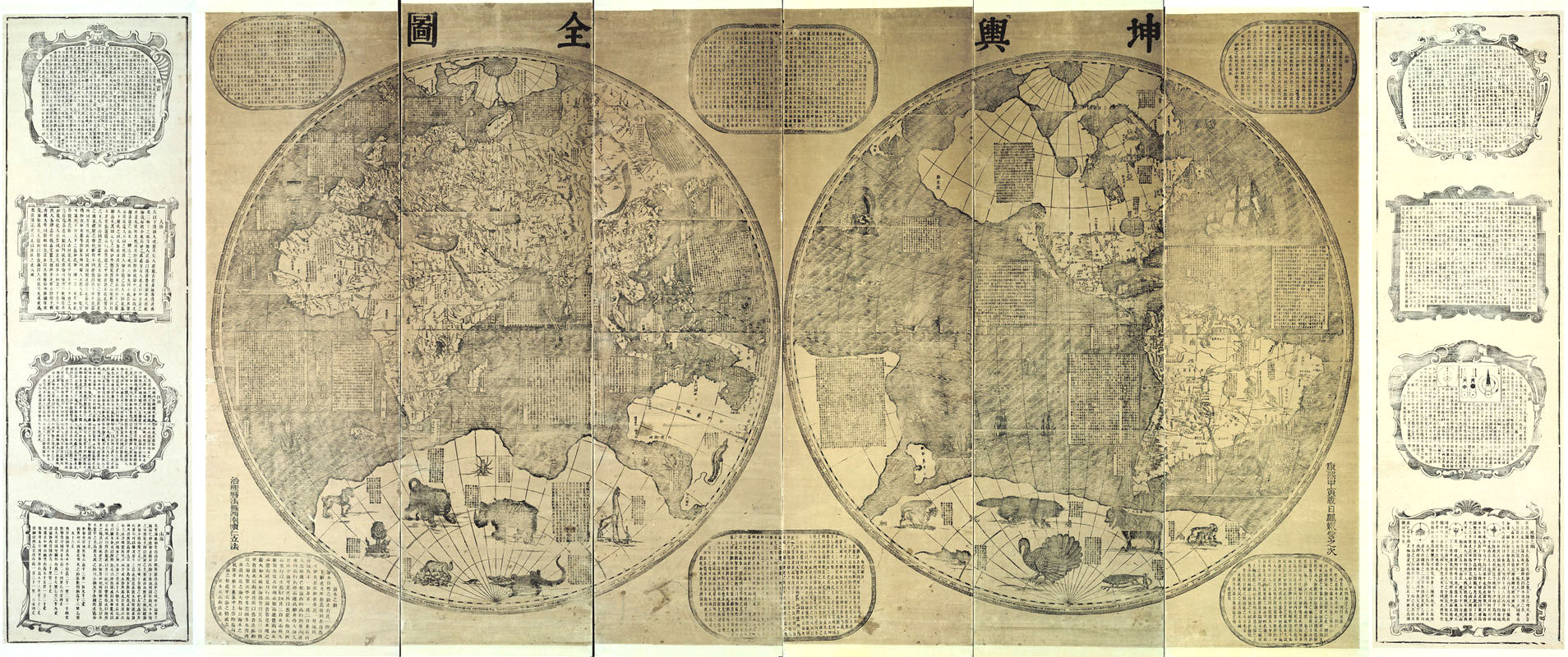
Another of Verbiest’s masterpieces was his 1674 world map. Each of the eight sections was 5.8 foot by 1.77 foot sections. (6) The Verbiest map was part of a larger geographical work, ‘Illustrated Discussion of the Geography of the World.’ (5) (An amazing interactive version of Verbiest’s map here: http://verbiest.asianart.org)
The world map was quite marvelous. Besides the map itself, Verbiest included all sorts of secondary details to enhance the appearance or usefulness. The entire map bears signs of diligent craftsmanship from the oceans of carefully crafted waves to the intricate illustrations of animals. (3) Verbiest included a variety of fantastic animals, from the mighty unicorn to the humble beaver. (3) Each animal featured a short encyclopedic entry next to it. In fact, nearly all of the map was filled with annotations of one kind of another. Verbiest placed fourteen major essays around the exterior of the map to explain various high-level concepts including astronomy, humanity and morals, the ‘four’ elements, earthquakes. (3)
Verbiest also included whatever details he knew of the countries around the world and the inhabitants therein. (3) While there are some incorrect details, such as the cause of earthquakes, the inclusion of unicorns as real animals, and the portrayal of California as an island, the scale of the map is incredible. The entire map is filled with annotations in Chinese and Antarctica in particular is sprinkled with animal images and descriptions. (3)
Verbiest had converted many respected people including mandarins, princes, and scholars. Between his work and the other Jesuit missionaries, there were 800,000 Catholics in China when he died. (1)
Jean Baptiste Carnoy, Belgian priest and microbiologist. (5) In 1884, Carnoy wrote a book detailing Cellular Biology Comparative Study in the Two Kingdoms. Even the very start of the book has valuable information as it lays out a few basic facts about his situation. Carnoy was a teacher of botany and biology, with a doctorate in natural sciences at the Catholic University of Louvain. (5) He first came to the school in 1876 with the express intent of creating a microscope laboratory to study cell biology. He acknowledges the assistance given by the bishops over the years as he has, as of 1884, close to two hundred students, Belgian or foreign, eager to learn. (5)
Carnoy wanted systemic changes to the process of teaching, and a greater focus on cytology, the study of plant and animal cells. Carnoy’s desire was to, as fully as possible given the current state of science, study cytology in general. (5) Carnoy pointed out that, at the time, there were no courses on the subject of cellular biology, outside of Louvain,yet the esteemed Walther Flemming, founder of the field of cytology, believed all illnesses or biological functions would ultimately have to be traced back to the individual cells to be understood, thereby necessitating a good understanding of the inner workings of cells.(4, 5) Carnoy additionally argued that biology at the time was advancing against all logic because they tried to tackle the complex systems before understanding the basic systems, the cells. (5)
Furthermore, the study must be general enough to draw comparisons between animal and plant life for completeness as all cells have great similarities. Carnoy also explained the current methods for teaching cellular biology were far too heavily reliant on theory at the time and because the faculty were unwilling to adapt to the changing understanding of science, cytology would be stymied simply due to systemic flaws. Instead, he declared cytology could only be taught in labs with microscopes so the across to students could see the cell for themselves, feel the excitement of watching these processes unfold, not simply memorize information. (5)
Belgium, Frans Alfons Janssens, 1865-1924
While teaching at the university, Carnoy had a student named Frans Alfons Janssens who would go on to be his protegé. Janssens was also Belgian priest and went on to carry on Carnoy’s work after his death. (4) Janssens had a wide variety of knowledge, studying theology and creating a zoology thesis while studying with Carnoy. (4) After graduating from Louvain, Janssens visited France, Italy, and the Netherlands before returning to Belgium to teach at Louvain.(4)
One of his significant contributions to biology was in advancing Mendel’s theories. In 1909 he published a paper, The Theory of Chiasmatype, in discussing how the chromosomes combined in meiosis and mixed to give rise to the differences Mendel observed. (4) Actually, he had a draft completed in 1908 and dropped it off at the Belgian Royal Academy even though he was not a member.
The current theory believed that the parental and maternal chromosomes lined up at opposite sides of the cell and then divided on their own separate corners to account for the genetic mixing that was known to occur due to Mendel’s data.(4)
Furthermore, the theory was that divisions of the same chromosomes stayed together, though this failed to explain the grand diversity of traits. If all the chromosomes stayed in their own separate areas, there would be no way for the volume of diversity observed. (4)
In his research Janssens used a camera lucida, a device that allowed an artist to look at the paper and see the subject simultaneously, to capture sketches of the action.4 Among other things, he found the parental and maternal chromosomes were not simply contacting each other, but actually breaking apart and reassembling combined with each other. (4)
He was clearly excited at the time, hoping he had successfully described one of the secrets of meiosis, musing that “time will tell,” which it did. (4) Although his his findings were not greatly appreciated at the time, nowadays his findings are so thoroughly accepted they are simply part of biology taught at any school.


.jpg)