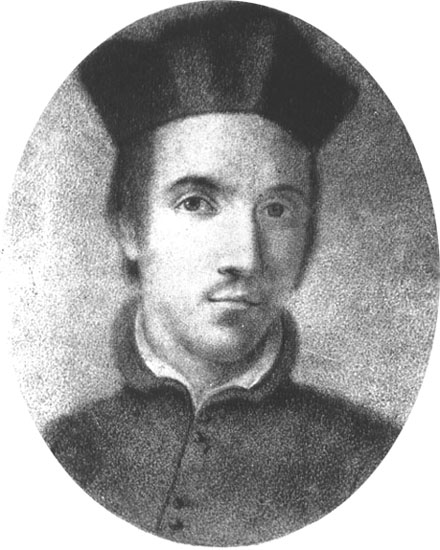
Niccolo Cabeo (1561-1636)
Cabeo, a Catholic priest who joined the Jesuits in 1602, is known for his two major publications, Philosophia magnetica (Magnetic philosophy)and In quatuor libros meteorologicorum Aristotelis commentaria (Commentary in four books on Aristotle’s Meteorology).(1)
His academic career happened mainly in Parma, following typical Jesuit curriculum, and included studying logic, natural philosophy, metaphysics, and theology, as well as mathematics.(1) After finishing his studies in 1616, he taught theology, philosophy, and metaphysics at Parma until 1621, then spending several years living at the Jesuit college in Ferrara, his birthplace, and also taught theology in the late 1620s.(1)
His first book explained not only his own experimental investigations of terrestrial magnetism but also Gilbert’s, as well as explaining magnetized iron and lodestone, the mineral magnetite. (2) He also contributed to physics experiments, observing the Giovanni Battista Baliani experiments about falling objects.(2)
He also experimented with pendulums.(2) Niccolo thought that the earth was immobile, and had no magnetic field.(1) In his first book Philosophia magnetica Cabeo stressed that all of his work sought out the causes of natural effects, saying that every discussion and idea he had was based upon experimental work, with the experiments being repeatedly performed.(2) Cabeo also confirmed Galileo’s claims that two bodies, no matter the weight, tend to fall at the same rate, as opposed to the heavier one falling faster, as long as they were of the same material.(2)
At the end of his life, he returned to teaching at a Jesuit college.(1)
Niccolo Cabeo presented a new style of natural and experimental philosophy, becoming one of the most influential Jesuit natural philosophers of his time.(2)
Sources cited:
Cabeo, Niccolo https://www.encyclopedia.com/people/science-and-technology/physics-biographies/niccolo-cabeo
(2) Niccolo Cabeo https://prezi.com/s8qaxwvififh/niccolo-cabeo/
Showing posts with label italian. Show all posts
Showing posts with label italian. Show all posts
Friday, August 10, 2018

Tuesday, August 7, 2018
Alessandro Serpieri
Alessandro Serpieri (1823-1885) Known for his work in seismic waves and meteor showers
Alessandro Serpieri was born at S. Giovanni in Marignano, near Rimini.(1) He received his early education from the priest brothers Speranza in Rimini.(1) His classical studies were at College of the Scolopians in Urbino, of which the distinguished Latin scholar, Father Angelo Bonucelli, was the rector.(1) He entered their novitiate at Florence in November of 1838.(1) He studied philosophy and the exact sciences for three years at the Ximenian College.(1) Serpieri was only 20 when he was appointed instructor for the college in Siena, where excelled and became known as a model teacher due to his clear style of exposition, his eloquence, and his manners.(1)
Three years later, in 1846, his superior appointed him professor at the college of Urbino. (1) Two months after that, the Papal government chose him for the chair of physics in the same city.(1) Two years later, he was ordained priest, and in 1857 he became rector of the college. During his time at the college, he applied himself to astronomy, theoretical and experimental physics, meteorology, and specifically seismology.(1)
In astronomy, his major work was in shooting stars, where he discovered that the August meteors originate near Gamma Persei, and established an observatory at Urbino. His work on the electric potential… was praised for its system, clearness, and conciseness.(1)
He also worked on absolute measures, especially in physics. His chief accomplishments, however, were in the field seismology. His major work was discovering what caused animal “premonitions” before an earthquake and managing to invent a device that detected start location, direction and time of seismic waves cheaply and easily. The device’s design, however, was lost, and we only have general descriptions and images of this device.(2)
His career at the college ended, however, when, in 1884, the secularization of education began. While he could have remained at the college, he resigned to show his disgust in such an unjust decree. This shock, combined with his already failing health, caused a near-fatal shock, and he died a year later, in 1885.
Works Cited
(1) Alessandro Serpieri http://www.newadvent.org/cathen/13730a.htm
(1) The Nineteenth Century http://physlab.uniurb.it/Physics04.html
Monday, June 18, 2018
Lazzaro Spallanzani
Italy 1729-1799

Lazzaro Spallanzani was born in 1729. “He attended the Jesuit college at Reggio, where he received a sound education in the classics and philosophy.” However, rather than join the Jesuit order, he began to study law. Then his cousin, Laura Bassi, got him interested in science, (1&2) and “at twenty-five he became professor of logic, metaphysics, and Greek in the University of Reggio.” (2) Around the same time, he was also in seminary; he was ordained as a priest in 1757.
“Spallanzani read voraciously but was a persistent skeptic, hesitant to believe anything that he could not prove himself” (3), which turned out to be very important when it came to animalcules, as the scientists who originally carried it out had not been as strenuous in their testing as they should have been. (3) After Spanzalli carried out the tests himself, he published the outcome and criticized the original tests that had been performed. One of the scientists who published the original study sent Spanzalli a message which led to Spanzalli’s research on regeneration, for which he is now known.
In fact, it “was in biology that his work counted for most; his studies in regeneration are still classic.” (2) Among other things, he tested to see if snails could regrow their heads (they could; the brains of snails are not in their heads) (1), how salamanders regrow their tails, and what injuries earthworms could recover from (4). But he didn’t focus solely on regeneration. He also studied the digestive system, tested gravy to see whether Leeuwenhoek was correct to say that microscopic life were truly living organisms, and investigated the mechanics of skipping stones across water (1)
While his theories about digestion and limb regeneration bested those of his contemporaries, Spallanzani did not lord it over them, at least not where they could see, hear, or ever find out about it. (1&4) It is known that his theories likely bested those of his contemporaries because of his “vigorous use of scientific methodologies” (3)
Additionally, Spallanzani’s research into “the development of microscopic life” was a vital link between Antonie von Leeuwenhoek's discovery of animalcules in 1676 and “the research of Louis Pasteur” which took place in 1849, over 170 years later. (1)
Works Referenced
- Lazzaro Spallanzani https://www.britannica.com/biography/Lazzaro-Spallanzani
- Lazzaro Spallanzani http://www.newadvent.org/cathen/14209a.htm
- Lazzaro Spallanzani (1729-1799) https://embryo.asu.edu/pages/lazzaro-spallanzani-1729-1799
- Regeneration according to Spallanzani https://onlinelibrary.wiley.com/doi/full/10.1002/dvdy.22057
Statue in Scandiano, Italy


Lunar Crater Named for Spallanzani

Spallanzani Mars Crater
Spallanzani Mars Crater

Antonio Neri
Italy 1576-1614

Antonio Neri was an alchemist, a glassmaker, and a priest. He worked for a prince of the Medici family. (1&4) He was known for his “careful experimentation and research.” (1) Born in 1576, by 1612 he had developed a new technique: “the addition of a minute amount of gold to the molten mixture of glassmaking materials,” which created ”a glass of a brilliant ruby color.” To this day, the technique cannot be mass-produced, much like the papermaking process of the 17th century. (2)
At the time, glassmaking was a difficult process, and an important secret so it was carefully guarded. Venice was known as the glassmaking capital of Europe, producing the finest glass. As long as Venice held the secret of cristallo,”a sophisticated Venetian specialty renowned for its delicate clarity”(1), the Venetians maintained control over the market. Neri, however, cared more for the dissemination of information than the superiority of the Venetian economy.
He “is famously known as the author of the first book devoted to the subject of making glass—L'Arte Vetraria,” (1) which was published the same year that he came up with the gold-and-glass technique. His book is especially shocking when one considers that at the time, such information was handed down in secret from master to apprentice. The expectation was that anyone who knew the answer to creating the finest glass would themselves desire to keep the information close, which led to lost information every time a master died unexpectedly, and a complete shock to the people of Venice when Neri’s book was released.
Before 1800 AD, Neri’s book was translated into Latin, German, and French (3), and become the standard reference for glassmaking across Europe. (1) Additionally, ten years after the book was published, “an English company sent six Italian glassmaking artisans to the Jamestown colony,” despite the fact that the Venetian government had moved all glassmakers to an island named Murano in order to keep the secret years before the book was published. Neri's book also allowed glassmakers to build on old techniques and revolutionize the industry.
Previously, pioneering families, colonists, and people in old villages all had to make due with substitutes like oiled paper. While this allowed light in, it failed to provide a view of the outdoors.
With good high clarity glass, which was much more transparent, people could see their neighborhoods better, which some claim led to an increased respect for good hygiene; this in turn saved hundreds upon thousands of lives. (2).
Neri, a Catholic priest, would be glad to know that his book has been a huge contribution both to the field of glassmaking and to the field of medicine. (3) His contributions helped Galileo Galilei, another Florentine discover the moons of Jupiter. Shortly after Neri’s death in 1914, Galileo contributed to the distribution of this book by sending a copy to a friend in Rome. (1)
Works Referenced
Works Referenced
- Antonio Neri: Alchemist, Glassmaker, Priest https://www.cmog.org/article/antonio-neri-alchemist-glassmaker-priest
- Antonio Neri Reveals the Secrets of Glassmaking And Helps Make High Quality Glass Available To The World https://www.encyclopedia.com/science/encyclopedias-almanacs-transcripts-and-maps/antonio-neri-reveals-secrets-glassmaking-and-helps-make-high-quality-glass-available-world
- Antonio Neri http://www.newadvent.org/cathen/10752a.htm
- The art of glass : wherein are shown the wayes to make colour glass, pastes, enamels, lakes, and other curiousities https://archive.org/details/TheArtOfGlassWhereinAreShownTheWayesToMakeAndColourGlass
Thursday, June 14, 2018
Francesco Lana de Terzi
Italy 1631-1687
The Italian Jesuit is famous as the Father of Aeronautics because of his idea to create a flying machine based in (nearly completely) sound science. (1) He planned to use spheres of copper, with vacuums inside, to produce the necessary lift, having calculated the necessary size to sustain itself along with passengers. (1) His design is interesting because it used known, functional, technology of the day with strict mathematical calculations and scientific theories to create a successful design. (1, 3)
However, there were a number of considerations that prevented its construction. Lana de Terzi attempted to respond to these in his book, such as the idea that the riders of the flying machine would be flown into space. (1) Lana de Terzi responded that the weight of the ship would prevent the vacuum-filled balloons from reaching outer space, and that onboard valves would reintroduce air to the spheres and provide the capability of successful landing. (1) As for the claim that his balloons would not stand up against atmospheric pressure, he argued the spherical shape would help to withstand the pressure. This idea is flawed, though an interesting attempt.
However, one of the reasons he was wrong on this point was that he never constructed the machine, and this for several reasons.(4) First and foremost, his vow of poverty. (1) Lana de Terzi had calculated there was no way for him to fund the machine on his own, and consequently was forced to rely solely on theory. (1) One of the more existential issues was the threat to all civilization. (1) He feared such airships could be used to lay waste to cities with impudence, raining down destruction with any manner of projectile. When aircraft actually were created, this fear came to fruition within fifty years, so he was correct to consider the threatening possibilities of flight(1)
It is extremely interesting that we consider him the father of Aeronautics despite all of these considerations and limitations. Lastly, it has been alleged that his ideas were essentially just, reused versions of others’ work. (4) But all of this is fails to see the rest of his work.
His idea for a flying machine was published in a book which was entitled -- in part -- ‘Promodero, wise overseer of some new inventions’ ( A link which contains pdf verison photographed in the original Italian is here https://www.e-rara.ch/zut/content/titleinfo/9958403). (1, 3). However, the idea for constructing the balloon airship only took up only one of the chapters of the volume. The previous chapter was dedicated to the idea of flight similar to that of birds, and between them Lana de Terzi distinguished between heavier than air flight and lighter than air flight. (3)
However, outside of those two chapters, the rest of the book was not concerned with flight at all. Instead, the purpose of the book was twofold: To explain the myriad inventions he had theorized and to generate attention for his actual scientific work. (1, 3) One of his ideas was to create a language for the blind, which was actually extremely similar to braille despite preceding Louis Braille by over 150 years. His design was groundbreaking because it relied on a series of dashes to communicate the language rather than attempting to stick directly to the traditional alphabet, as the systems of the time did. Much like his idea for flight, the invention was never actually completed, though it is quite a compelling idea. (5)
The scientific knowledge which Lana de Terzi was publicizing was a planned nine-volume work, named Mastery of Nature and Art, to encapsulate the natural sciences and based in certainty through experiments and geometry. (3) He only managed to publish two, though another was published after his death. (3)
He was also interesting because he was trying to change the accepted ideas of the day in regard to ancient philosophers and magnetism. Lana de Terzi wished to have a variety of sources in use, and compare and contrast them rather than assuming a single source will have all the answers. He argued that science was inhibited by unnecessary fixations on particular sources, such as Aristotle. (2) Lana de Terzi’s attitude was that if Aristotle was wrong, as he was bound to be at some point, one must be willing to learn from some other scientist. (2)
Lana de Terzi was not the only scientist with these claims, but rather represented the new trend of scientists who wished to break with tradition where it did not function. In particular, he was frustrated by the idea that materials’ qualities were part of their ‘nature.’ He remarked annoyedly that if you asked nearly any natural philosopher of his day about anything they would say it was simply “such is the nature of that substance… [why does] a magnet draw iron and not straw, and amber draw straw and not iron?’ They reply this is the nature of amber and that is the nature of the magnet.” (2, pg 17). Altogether a circular argument and therefore unhelpful. Lana de Terzi wanted to break from this tradition by examining the actual causes of the world, hence his attempt at a nine volume collection of science.
It is rather sad then, that we remember him for only his airship. While it relied on a new piece of technology, the vacuum pump, it fails to really show what Lana de Terzi wished to do. (1) It shows that he knew how to predict possible issues with aircraft, but it ignores his desire to revolutionize science. Of all his work, we remember one chapter of the one book he created to generate enough publicity to sell his actual science and this one achievement wasn’t even something that he actually accomplished, nor was it necessarily something he wanted to have happen.
Works Referenced
- Francesco Lana-Terzi, S. J. (1631-1687 The Father of Aeronautics http://www.faculty.fairfield.edu/jmac/sj/scientists/lana.htm
- Elements of Early Modern Physics https://books.google.com/books?id=vBH0vBmG61IC&pg=PA163&dq=Elements+of+Early+Modern+Physics+By+J.+L.+Heilbron+#v=onepage&q=lana&f=false
- Francesco Lana http://www.newadvent.org/cathen/08772c.htm
- The Rational Mechanics of Flexible Or Elastic Bodies https://books.google.com/books?id=gxrzm6y10EwC&printsec=frontcover&source=gbs_ge_summary_r&cad=0#v=onepage&q=francesco%20&f=false
- Foundations of Opthalmology: Great Insights that established the discipline https://books.google.com/books?id=4kszDwAAQBAJ&pg=PA46&lpg=PA46&dq
Wednesday, June 13, 2018
Luca Pacioli
Italy 1445-1517

Luca Pacioli was a Franciscan Friar who taught at the University of Perugia and gained the Chair of Mathematics in 1477. (1) While at Perugia, Pacioli wanted his students to be able to apply the math they were learning, an uncommon tactic at the time. (4) Pacioli became a travelling mathematician in 1480, and arriving in Rome in 1487. The Pope, Sixtus IV, gave him particular privileges, causing friction between Pacioli and other Franciscans when Pacioli attempted to return to teach at his hometown, Sansepolcro. As a result, he was banned from teaching in 1491, though their stance had changed somewhat by 1493, since he was then invited to preach during Lent. (1, 2)
Pacioli wrote his first treatise on mathematics when he was nineteen, and created various other publications throughout his life. (1) His most influential work, published in 1494, was entitled The Collected Knowledge of Arithmetic, Geometry, Proportion, and Proportionality. This work was essentially an all-in one reprint of a variety of master mathematicians. Paicoli had not invented the math, merely repackaged it. (4) Still, it was a start and encouraged mathematical progress over the next decades. (2)
One particular piece of this work was of particular interest due to its effect on the field of accounting, the area which Pacioli is now most famous for.(4) Pacioli started, or at least was the first to record, the double entry bookkeeping system, the use of ledgers, and income statements. (1) The double entry system means a company would note money spent on food, for example, as negative in the general funds section, and positive in the food expense column. As long as the total amount of money doesn’t magically increase, this system helps to provide a clear indication of where money is being spent. (3) Pacioli altered the field of accounting so thoroughly he is now considered the Father of Accounting. (4)
The Collected Knowledge... was widely read and made Pacioli famous. (4) He was invited to Milan around 1496 and there met Leonardo da Vinci. The two became friends and spent the next seven years teaching each other what they knew of art and math. (4) Pacioli had learned from the painter and mathematician Piero della Francesca, an early architect of perspective in art. (2) Pacioli taught Leonardo about perspective which was then aplied in the Last Supper painting. Leonardo provided illustrations for another of Pacioli’s books, The Divine Proportion. (2, 4) The Divine Proportion was concerned with the properties of the Golden Ratio, which Paicili considered so sublime he compared to God. (5) Their friendship is fairly certain, as Da Vinci often mentioned Pacioli in his notes. (4)
Towards the end of his life, Pacioli once more returned to his hometown, and may have become abbot of the monastery there, though his four year stay ended in 1514 as he was summoned to Rome by the Pope. (4) Unfortunately, he died in 1517, before making the journey to Rome. (4) Unlike so many other mathematicians and scientists, Pacioli was actually able become famous within his own lifetime. Quite often, the merits of a scientist’s work is not appreciated until another person duplicates their findings and happens upon the former scientist at some later point. Nor has Pacioli’s work faded into obsolescence: a version of his system is still in use today. (2)
Works Referenced
- Luca Pacioli https://famous-mathematicians.com/luca-pacioli/
- Luca Pacioli http://www-history.mcs.st-andrews.ac.uk/Biographies/Pacioli.html
- What is Double Entry Bookkeeping? https://www.accountingcoach.com/blog/what-is-double-entry-bookkeeping
- Luca Pacioli: The Father of Accounting http://flynf.tripod.com/pacioli.htm
- The Divine Proportion by Luca Pacioli http://www-history.mcs.st-andrews.ac.uk/Extras/Divine_proportion.html
Subscribe to:
Posts (Atom)