Giovanni Agostino Panteo, known in Latin as Joannes Antonius Pantheus, was a Venetian priest and alchemist. Panteo wrote the Ars transmutationis metallicae (the art of transmutation of metals), spoke out against fake alchemy and separated alchemy from archime. Alchemy was concerned only with changing the surface of objects.
Panteo’s book has been credited as an important and very early contribution to atomism, the precursor to modern atomic theory.(1) Atomism is a theory which states that there are two fundamental principles, atoms and void (or NOT atoms). Atoms are indestructible because they cannot be divided any further and construct all macroscopic objects by combining with other atoms.(2)
Works Referenced
Ars Transmutationis Metallicae ... [with, as issued] Commentarium theoricae Artis Mettalicae Transmutationis. https://www.sophiararebooks.com/pages/books/4395/pantheus-or-panteo-or-pantheo-giovanni-agostino/ars-transmutationis-metallicae-with-as-issued-commentarium-theoricae-artis-mettalicae
Atomism https://en.wikipedia.org/wiki/Atomism
Giovanni Agostino Panteo https://fr.wikipedia.org/wiki/Giovanni_Agostino_Panteo
Pantheo, Giovanni Agostino active approximately 1517-1535 http://worldcat.org/identities/lccn-no2004070057/
Giovanni Agostino Panteo http://historyofalchemy.com/list-of-alchemists/giovanni-panteo/
Showing posts with label chemistry. Show all posts
Showing posts with label chemistry. Show all posts
Saturday, August 11, 2018

Friday, June 22, 2018
Jean-Baptiste Senderens
France, (1856–1937)

Jean-Baptiste Senderens was “a chemist, canon and Doctor of Science and Philosophy,” and “had great manual skill, consistency and perseverance” in his laboratory work.” (3) In 1899, Jean-Baptiste Senderens worked with Paul Sabatier (1) and developed a “method of organic synthesis employing hydrogenation and a heated nickel catalyst. [It is still] employed commercially for hydrogenating unsaturated vegetable oils to make margarine.” (4) Sabatier and Senderens had both studied under Filhol, a Professor of Chemistry in Toulouse, and it is said that their work is so close that it is impossible to distinguish the work of either man. (3)(0)
Jean-Baptiste was “one of the most active workers in the field of contact catalysis.” (2) “In 1908 Poulenc Frères gave Senderens the title of Engineer and asked him to set up their laboratories and organic chemistry industry. Manufacturing was done at the Catholic University by three or four chemists working under Senderens” (3) “In 1923 Senderens was made a Knight of the Legion of Honour for his contributions to Poulenc's manufacture of war materials.” (3b)
However, very little information can be found about him today, and while Sabatier was awarded a Nobel Prize (5), it is unclear what level of recognition Senderens got for doing an equitable amount of work on the same project.
(1) Senderens, Jean Baptiste https://www.encyclopedia.com/education/dictionaries-thesauruses-pictures-and-press-releases/senderens-jean-baptiste
(2) Obituary https://www.nature.com/articles/141148a0
(3) Jean Baptiste Senderens https://en.m.wikipedia.org/wiki/Jean-Baptiste_Senderens
(4) Sabatier-Senderens process http://www.oxfordreference.com/view/10.1093/oi/authority.20110803100435402
(5) Paul Sabatier - Nobel Lecture https://www.nobelprize.org/nobel_prizes/chemistry/laureates/1912/sabatier-lecture.html
Monday, June 18, 2018
Antonio Neri
Italy 1576-1614

Antonio Neri was an alchemist, a glassmaker, and a priest. He worked for a prince of the Medici family. (1&4) He was known for his “careful experimentation and research.” (1) Born in 1576, by 1612 he had developed a new technique: “the addition of a minute amount of gold to the molten mixture of glassmaking materials,” which created ”a glass of a brilliant ruby color.” To this day, the technique cannot be mass-produced, much like the papermaking process of the 17th century. (2)
At the time, glassmaking was a difficult process, and an important secret so it was carefully guarded. Venice was known as the glassmaking capital of Europe, producing the finest glass. As long as Venice held the secret of cristallo,”a sophisticated Venetian specialty renowned for its delicate clarity”(1), the Venetians maintained control over the market. Neri, however, cared more for the dissemination of information than the superiority of the Venetian economy.
He “is famously known as the author of the first book devoted to the subject of making glass—L'Arte Vetraria,” (1) which was published the same year that he came up with the gold-and-glass technique. His book is especially shocking when one considers that at the time, such information was handed down in secret from master to apprentice. The expectation was that anyone who knew the answer to creating the finest glass would themselves desire to keep the information close, which led to lost information every time a master died unexpectedly, and a complete shock to the people of Venice when Neri’s book was released.
Before 1800 AD, Neri’s book was translated into Latin, German, and French (3), and become the standard reference for glassmaking across Europe. (1) Additionally, ten years after the book was published, “an English company sent six Italian glassmaking artisans to the Jamestown colony,” despite the fact that the Venetian government had moved all glassmakers to an island named Murano in order to keep the secret years before the book was published. Neri's book also allowed glassmakers to build on old techniques and revolutionize the industry.
Previously, pioneering families, colonists, and people in old villages all had to make due with substitutes like oiled paper. While this allowed light in, it failed to provide a view of the outdoors.
With good high clarity glass, which was much more transparent, people could see their neighborhoods better, which some claim led to an increased respect for good hygiene; this in turn saved hundreds upon thousands of lives. (2).
Neri, a Catholic priest, would be glad to know that his book has been a huge contribution both to the field of glassmaking and to the field of medicine. (3) His contributions helped Galileo Galilei, another Florentine discover the moons of Jupiter. Shortly after Neri’s death in 1914, Galileo contributed to the distribution of this book by sending a copy to a friend in Rome. (1)
Works Referenced
Works Referenced
- Antonio Neri: Alchemist, Glassmaker, Priest https://www.cmog.org/article/antonio-neri-alchemist-glassmaker-priest
- Antonio Neri Reveals the Secrets of Glassmaking And Helps Make High Quality Glass Available To The World https://www.encyclopedia.com/science/encyclopedias-almanacs-transcripts-and-maps/antonio-neri-reveals-secrets-glassmaking-and-helps-make-high-quality-glass-available-world
- Antonio Neri http://www.newadvent.org/cathen/10752a.htm
- The art of glass : wherein are shown the wayes to make colour glass, pastes, enamels, lakes, and other curiousities https://archive.org/details/TheArtOfGlassWhereinAreShownTheWayesToMakeAndColourGlass
Friday, April 13, 2018
Eugenio Barsanti
Italy, 1821-1864
Eugenio Barsanti was a gifted mathematician and physicist, who together with Felice Matteucci, a hydraulic engineer from Florence, invented the first version of the internal combustion engine in 1853. Their patent request was granted in London on June 12, 1857, and published in London’s Morning Journal under the title “Specification of Eugene Barsanti and Felix Matteucci, Obtaining Motive Power by the Explosion of Gasses”.
Barsanti was born in Pietrasanta, Tuscany. Lean and short of stature, he studied in a Catholic scientific-oriented institute near Lucca, in Tuscany, and became a novitiate of the Piarist Fathers or Scolopi, in Florence in 1838. In 1841 Barsanti began teaching in the Collegio San Michele, situated in Volterra. Here, during a lecture describing the explosion of mixed hydrogen and air in a new electric pistol invented by Alessandro Volta, he realised the potential for using the energy of the expansion of combusting gases within a motor.
He soon transferred to Ximeniano Institute in Florence. where he met Matteucci, who was engaged in a land reclamation project in Florence. Matteucci appreciated the idea for the engine, and the two men worked together on it for the rest of their lives. Together, they succeeded in design and producing a number of the first type of gas engines to produce a vacuum within a closed cylinder, atmopsheric pressure then being utitlized to produce the power stroke. The principle was demonstrated in 1820, was used by Samuel Brown in 1827, and much later by N.A. Otto in 1867. On 13 May 1852, Barsanti and Matteucci received British Provisional Patent no. 1072. The patent was created in London, as Italian law at that time could not guarantee sufficient international protection. The first prototype was built in 1856 as a two-cylinder 5 HP motor. They petitioned for a second British patent (no. 1655), which was granted on 12 June 1857. On 30 December 1857, the State of Piemonte granted the directive (Patent) No. 579 and in close succession came the French patent dated 9 January 1858, No. 35009, and the Belgian patent dated 10 February 1858, No. 5533. By 1858, they had built a counter-working two-piston engine. A third engine was made in 1860 for the first National Exhibition in Florence, Italy, in 1861.
The main advantage of the Barsanti-Matteucci engine was the use of the return force of the piston due to the cooling of the gas. Other approaches based on the propulsive force of the explosion, like the one developed by France’s Etienne Lenoir, were slower. The Barsanti-Matteucci engine was five times more efficient, and won a silver medal from the Lombardy Institute of Science. It was intended to provide mechanical energy in factories and for naval propulsion. It was not light enough for use as an automotive engine. Barsanti and Matteucci selected the John Cockerill foundry in Seraing, Belgium to mass-produce a 4 hp (3.0 kW; 4.1 PS) engine. Before leaving for Belgium, Barsanti addressed His Holiness to ask for the ‘Apostolic Blessing’. Pope Pius IX had been schooled by the Scolopi in precisely the same Volterra school where, many years later, Barsanti had his first teaching assignment. Orders for the engine soon followed from many countries within Europe. Unfortunately, 48 hours before supervising mass production was to start at Cockerill in Seraing, Belgium, Barsanti fell ill with typhoid. He died shortly after, on 19 April 1864. Matteucci, himself very ill, gave up the enterprise and eventually returned to engineering.
Eugenio Barsanti was a gifted mathematician and physicist, who together with Felice Matteucci, a hydraulic engineer from Florence, invented the first version of the internal combustion engine in 1853. Their patent request was granted in London on June 12, 1857, and published in London’s Morning Journal under the title “Specification of Eugene Barsanti and Felix Matteucci, Obtaining Motive Power by the Explosion of Gasses”.
Barsanti was born in Pietrasanta, Tuscany. Lean and short of stature, he studied in a Catholic scientific-oriented institute near Lucca, in Tuscany, and became a novitiate of the Piarist Fathers or Scolopi, in Florence in 1838. In 1841 Barsanti began teaching in the Collegio San Michele, situated in Volterra. Here, during a lecture describing the explosion of mixed hydrogen and air in a new electric pistol invented by Alessandro Volta, he realised the potential for using the energy of the expansion of combusting gases within a motor.
He soon transferred to Ximeniano Institute in Florence. where he met Matteucci, who was engaged in a land reclamation project in Florence. Matteucci appreciated the idea for the engine, and the two men worked together on it for the rest of their lives. Together, they succeeded in design and producing a number of the first type of gas engines to produce a vacuum within a closed cylinder, atmopsheric pressure then being utitlized to produce the power stroke. The principle was demonstrated in 1820, was used by Samuel Brown in 1827, and much later by N.A. Otto in 1867. On 13 May 1852, Barsanti and Matteucci received British Provisional Patent no. 1072. The patent was created in London, as Italian law at that time could not guarantee sufficient international protection. The first prototype was built in 1856 as a two-cylinder 5 HP motor. They petitioned for a second British patent (no. 1655), which was granted on 12 June 1857. On 30 December 1857, the State of Piemonte granted the directive (Patent) No. 579 and in close succession came the French patent dated 9 January 1858, No. 35009, and the Belgian patent dated 10 February 1858, No. 5533. By 1858, they had built a counter-working two-piston engine. A third engine was made in 1860 for the first National Exhibition in Florence, Italy, in 1861.
The main advantage of the Barsanti-Matteucci engine was the use of the return force of the piston due to the cooling of the gas. Other approaches based on the propulsive force of the explosion, like the one developed by France’s Etienne Lenoir, were slower. The Barsanti-Matteucci engine was five times more efficient, and won a silver medal from the Lombardy Institute of Science. It was intended to provide mechanical energy in factories and for naval propulsion. It was not light enough for use as an automotive engine. Barsanti and Matteucci selected the John Cockerill foundry in Seraing, Belgium to mass-produce a 4 hp (3.0 kW; 4.1 PS) engine. Before leaving for Belgium, Barsanti addressed His Holiness to ask for the ‘Apostolic Blessing’. Pope Pius IX had been schooled by the Scolopi in precisely the same Volterra school where, many years later, Barsanti had his first teaching assignment. Orders for the engine soon followed from many countries within Europe. Unfortunately, 48 hours before supervising mass production was to start at Cockerill in Seraing, Belgium, Barsanti fell ill with typhoid. He died shortly after, on 19 April 1864. Matteucci, himself very ill, gave up the enterprise and eventually returned to engineering.
Thursday, May 4, 2017
Ruggiero Giuseppe Boscovich
A Dalmatian Jesuit and well-known mathematician, astronomer, and natural philosopher, b. at Ragusa, 18 May 1711; d. at Milan, 13 February, 1787. He was the youngest of six brothers and his education began at the Jesuit college of his native city. Being early impressed by the success achieved by his masters, he resolved to receive admission into their ranks, and on 31 October, 1725, at the youthful age of fourteen, he entered the novitiate of the Society of Jesus in Rome. His unusual talents manifested themselves particularly during the years devoted to literary and philosophical studies at the Collegio Romano, the most celebrated of the colleges of the Society of Jesus. Thus, for example, young Boscovich discovered for himself the proof of the theorem of Pythagoras. His professor, especially Father Horatio Borgondi, professor of mathematics, knew how to cultivate talents, and he made such progress, especially in mathematics, that he was able to take the place of his former professor at the Roman College even before the completion of his theological studies. As soon as he had completed the ordinary studies of a young Jesuit, he was appointed regular professor of mathematical science at the same college. He performed the duties of this office with much distinction for a whole generation, as is evidenced by the numerous Latin dissertations which he published nearly every year, according to the custom of the time. These show Boscovich's preference for astronomical problems. Among them may be mentioned:
Problems in pure mathematics as well as philosophical speculations regarding the various theories on the constitution of matter also engaged his attention and he took an active part in all scientific discussions which agitated the learned world of his time. To these belong his The Deviation of the earth from the probable Spherical Shape; Researches on Unusual Gravitation; The Computation of a Comet's Orbit from a Few Observations, etc. His able treatment of these and similar problems attracted the attention of foreign, as well as of Italian, Academies, several of which--among them Bologna, Paris, and London--admitted him to membership. At Paris he shared with the famous mathematician Euler the honor of having submitted the correction solution to a prize problem.
Boscovich also showed much ability in dealing with practical problems. To him was due the project of the Observatory of the Collegio Romano, which afterwards became so well known. He first suggested using the massive dome-pillars of the college church of St. Ignatius as a foundation, on account of their great stability. (The church dome has not yet been completed, so the pillars still await the substructure planned by the architect.) The unfavorable circumstances of the time, and the storms brewing against the Jesuits, which ended, as is well known, in the suppression of the Society, prevented Boscovich's plan from being carried out until 1850, when Father Secchi, his worthy successor, was able to bring it to completion. There is a close parallel, it may be observed, between these two coryphaei of the Roman College, and Boscovich may, without hesitation, be considered the intellectual forerunner of Secchi. Like Secchi, too, he was the advisor of the papal Government in all important technical questions. Thus, when in the middle of the eighteenth century the great dome of St. Peter's began to show cracks and other signs of damage, causing consternation to the pope and to the Eternal City, Boscovich was consulted, and the excitement was not allayed until his plan to place large iron bands about the dome was carried out. His advice was sought when there was a question of rendering innocuous the Pontine marshes and he was also entrusted with the survey of the Papal States. Pope Benedict XIV commissioned him and his fellow Jesuit, Le Maire, to carry out several precise meridian arc measurements, and it seems to have been due chiefly to his influence that the same pope, in 1757, abrogated the obsolete decree of the Index against the Copernican system.
Many universities outside of Italy sought to number Boscovich among their professors. He himself was full of the spirit of enterprise, as was shown when King John V of Portugal petitioned the general of the Jesuits for ten Fathers to make an elaborate survey in Brazil. He voluntarily offered his services for the arduous task, hoping thus to be able to carry out an independent survey in Ecuador, and so obtain data of value for the final solution to the problem of the figure of the earth, which was then exciting much attention in England and France. His proposal lead to the initiation of similar surveys in the Papal States, the pope taking this means of retaining him in his own domain. A detailed account of the results of the work appeared in a large quarto volume (Rome, 1755) entitled: "De litterariâ expeditione per Pontificam ditionem ad dimetiendos duos meridiani gradus et corrigendam mappam geographicam." A map of the Papal States made at the same time, which corrected many previous errors, proved to be likewise a wholesome contribution to the discussion regarding the more or less spherical form of the earth. Many of the triangulations were accomplished by no slight difficulties. The two base-lines employed in the survey--one on the Via Apia, the other in the neighborhood of Rimini--were measured with great care. The first was redetermined in 1854-55 by Father Secchi, as the mark indicating one end of the line measured by Boscovich and La Maire had been lost. (Cf. Secchi's work: Misura della Base trigonometrica esequita sull via Appia per ordine del governo pontifico, Roma, 1858.) Besides his work in mathematical astronomy, we also find Boscovich speculating, upon scientific grounds, on the essence of matter and endeavoring to establish more widely Newton's law of universal gravitation. As early as 1748 we meet essays from his pen in this field of thought, e.g. De materiae divisibilitate et du principiis corporum dissertatio (1748); De continuitatis lege et ejus consectariis pertinentibus ad prima materiae elementa eorumque vires (1754); De lege virium in natura existentium (1755); Philosophiae naturalis theoria redacta ad unicam legem virium in natura existentium (1758). Boscovich, according to the views expressed in these essays, held that bodies could not be composed of a continuous material substance, nor even of contiguous material particles, but of innumerable point-like structures whose individual components lack all extension and divisibility. A repulsion exists between them which is indeed infinitesimal but cannot vanish without compenetration taking place. This repulsion is due to certain forces with which these elements are endowed. It tends to become infinite when they are in very close proximity, whereas within certain limits it diminishes as the distance is increased and finally becomes an attractive force. This change is brought about by the diverse direction of the various forces.
Boscovich divided his last-mentioned exhaustive work into three parts, first explaining and establishing his theory, and then pointing out his applications to mechanical problems, and finally showing how it may be employed in physics. His attempt to reduce the complicated laws of nature to a simple fundamental law aroused so much interest that in 1763 a third, and enlarged edition of his "Theoria philosphiae naturalis" (Venice, 1763) had become necessary. The publisher added as an appendix a catalogue of Boscovich's previous works. There are no less than sixty-six treatises dating from 1736--a proof of his literary activity. Some have already been mentioned, and to these may be added his "Elementorum matheseos tomi tres," in quarto (1752).
Boscovich attracted attention by his political writings as well as by his scientific achievements. His Latin verses in which he eulogized the Polish king, Stanislaus, Pope Benedict XIV, and various Venetian noblemen, were read before the Arcadian Academy of Rome. His "Carmen de Solis ac Lunae defectibus" (5 vols., London, 1760) was much admired. His services were also in demand in several cities and provinces. Thus, in 1757, he was sent by the city of Lucca to the Court of Vienna to urge the damming of the lakes which were threatening the city. He acquitted himself of this task which such skill that the Luccans made him an honorary citizen and rendered him generous assistance on his scientific journeys, both in Italy, France, and England. While in England he gave the impulse to the observations of the approaching transit of Venus, on 6 June, 1761, and it is not unlikely that his proposal to employ lenses composed of liquids, to avoid chromatic aberration, may have contributed to Dolland's success in constructing achromatic telescopes. The citizens of Ragusa, his native town, besought him to settle a dispute in which they had become involved with the King of France--an affair which the pope himself deigned to adjust. Boscovich returned from England in company with the Venetian ambassador who took him by way of Poland as far as Constantinople. He availed himself of this opportunity to extend and complete his archeological studies in these countries, as may be gathered from his journal published at Bassano in 1784: "Giornale d'un viaggio da Constantinopli in Polnia con una relazione della rovine de Troja." The hardships of this journey shattered his health, yet we find him shortly after (1762) employed at Rome in various practical works, such as the draining of the Pontine marshes. In 1764 he accepted the appointment of professor of mathematics at the University of Pavia (Ticinum).
At the same time, Father Le Grange, the former assistant of Father Pezenas of the Observatory of Marseilles, was invited by the Jesuits of Milan to erect an observatory at the large college of Brera. He was able to avail himself of the technical skill of Boscovich in carrying out his commission and it may be questioned to which of the two belongs the greater credit in the founding of this observatory which, even in our own time, with that of the Collegio Romano, is among the most prominent of Italy. It was Boscovich who selected the southeast corner of the college as a site for the observatory and worked out the complete plans, including the reinforcements and the necessary remodeling for the structure. Building operations were immediately begun, and in the following year, 1765, a large room for the mural quadrants and meridian instruments, another for the smaller instrument, and a broad terrace, with several revolving domes to contain the sextants and equitorials, were completed. Such was the stability of the observatory that the new 18-inch glass of Schiaparelli could be mounted in it although a cylindrical dome of 13 yards, 4 inches now takes the place of the octogonal hall of Boscovich.
The London Academy proposed to send Boscovich in charge of an expedition to California to observe the transit of Venus in 1769, but, unfortunately, the opposition manifested everywhere to the Society of Jesus and leading finally to its suppression, made this impossible. He continued, however, to give his services to the Milan Observatory for whose further development he was able to obtain no inconsiderable sums of money. In particular the adjustment of the instrument engaged his attention, a subject about which he left several papers. But as his elaborate plans received only partial support from his superiors and patrons, he thought seriously in 1772 of severing his connection with the observatory, and, in fact, in the same year, Father La Grange was placed in complete charge of the new institution. Boscovich was to become professor at the University of Pisa, but Louis XV gained his services and invited him to Paris, where a new office, Director of Optics for the Marine--d'optique au service de la Marine--with a salary of 8,000 francs, was created for him. He retained this position until 1783 when he returned to Italy to supervise the printing of his as yet unpublished works in five volumes, for it was not easy to find a suitable publisher in France for books written in Latin. In 1785 there appeared at Bassano, "Rogerii Josephi Boscovich opera pertinentia ad opticam et astronomiam. . .in quinque tomos distributa," the last important work from the pen of this active man, who, after its completion, retired for a time to the monastery of the monks of Vallombrosa. He returned to Milan with new plans, but death shortly overtook him at the age of seventy-six, delivering him from a severe malady which was accompanied by temporary mental derangement. He was buried in the church of Santa Maria Podone.
Boscovich, by his rare endowments of mind and the active use which he made of his talents, was preeminent among the scholars of his time. His merits were recognized by learned societies and universities, and by popes and princes who honored him and bestowed favors upon him. He was recognized as a gifted teacher, an accomplished leader in scientific enterprises, an inventor of important instruments which are still employed (such as the ring-micrometer, etc.) and as a pioneer in developing new theories. All this, however, did not fail to excite envy against him, particularly in the later years of his life in France, where men like d'Alembert and Condorcet reluctantly saw the homage paid to the former Jesuit, and that, too, at a time when so many frivolous charges were being made against his lately suppressed order. This hostility was further increased by various controversies which resulted in differences of opinion, such as the contention between Boscovich and Rochon regarding priority in the invention of the rock crystal prismatic micrometer. (Cf. Delambre, Historie de l'Astronomie du XVIIIe siecle, p. 645.) The invention of the ring-micrometer, just mentioned, which Boscovich describes in his memoir "De novo telescopii usu ad objecta coelestia determinanda" (Rome, 1739), has been ascribed without reason by some to the Dutch natural philosopher Huygens. The chief advantage of the simple measuring instrument designed by Boscovich consists in its not requiring any artificial illumination of the field of the telescope. This makes it useful in observing faint objects, as its inventor expressly points out in connection with the comet of 1739. The novel views of Boscovich in the domain of natural philosophy have not, up to the present time, passed unchallenged, even on the part of Catholic scholars. Against his theory of the constitution of matter the objection has been raised that an inadmissible actio in distans is inevitable in the mutual actions of the elementary points of which material bodies are supposed to be composed. The theory therefore leads to Occasionalism. Acknowledgement must, however, must be made of the suggestiveness of Boscovich's work in our own day, and the germs of many of the conclusions of modern physics may be found in it. His illustrious successor at the Observatory of the Collegio romano, Father Angelo Secchi, in his "Unita delle forze fisiche" has in many respects followed in his footsteps, and in fact the cosmological views held by many later natural philosophers furnish unequivocal proof of the influence of the theories maintained by Boscovich.
Among his many smaller works (for a full list, cf. Sommervogel, cited below), the following deserve special attention: De annuis stellarum fixarum aberrationibus (Rome, 1742); De orbitus cometarum determinandis ope trium observationem parum a se invicem remotarum (Paris, 1774); De recentibus compertis pertinentibus ad perficiendam dioptricam (1767). His chief works, however, are:
The second was published in Vienna 1758-59, in Venice, 1763, and again in Vienna in 1764. The last-named work was subjected to an exhaustive criticism by Delambre, by no means a friend of the Jesuits. He closes with these words: Boscovich in general manifests a preference for graphical methods in the use of which he gives evidence of great skill. in his whole work he shows himself a teacher who prefers to lecture rather than to lose himself in speculations."
- The Sunspots (1736);
- The Transit of Mercury (1737);
- The Aurora Borealis (1738);
- The Application of the Telescope in Astronomical Studies (1739);
- The Figure of the Earth (1739);
- The Motion of the heavenly Bodies in an unresisting Medium (1740);
- The Various Effects of Gravity (1741);
- The Aberration of the Fixed Stars (1742).
Problems in pure mathematics as well as philosophical speculations regarding the various theories on the constitution of matter also engaged his attention and he took an active part in all scientific discussions which agitated the learned world of his time. To these belong his The Deviation of the earth from the probable Spherical Shape; Researches on Unusual Gravitation; The Computation of a Comet's Orbit from a Few Observations, etc. His able treatment of these and similar problems attracted the attention of foreign, as well as of Italian, Academies, several of which--among them Bologna, Paris, and London--admitted him to membership. At Paris he shared with the famous mathematician Euler the honor of having submitted the correction solution to a prize problem.
Boscovich also showed much ability in dealing with practical problems. To him was due the project of the Observatory of the Collegio Romano, which afterwards became so well known. He first suggested using the massive dome-pillars of the college church of St. Ignatius as a foundation, on account of their great stability. (The church dome has not yet been completed, so the pillars still await the substructure planned by the architect.) The unfavorable circumstances of the time, and the storms brewing against the Jesuits, which ended, as is well known, in the suppression of the Society, prevented Boscovich's plan from being carried out until 1850, when Father Secchi, his worthy successor, was able to bring it to completion. There is a close parallel, it may be observed, between these two coryphaei of the Roman College, and Boscovich may, without hesitation, be considered the intellectual forerunner of Secchi. Like Secchi, too, he was the advisor of the papal Government in all important technical questions. Thus, when in the middle of the eighteenth century the great dome of St. Peter's began to show cracks and other signs of damage, causing consternation to the pope and to the Eternal City, Boscovich was consulted, and the excitement was not allayed until his plan to place large iron bands about the dome was carried out. His advice was sought when there was a question of rendering innocuous the Pontine marshes and he was also entrusted with the survey of the Papal States. Pope Benedict XIV commissioned him and his fellow Jesuit, Le Maire, to carry out several precise meridian arc measurements, and it seems to have been due chiefly to his influence that the same pope, in 1757, abrogated the obsolete decree of the Index against the Copernican system.
Many universities outside of Italy sought to number Boscovich among their professors. He himself was full of the spirit of enterprise, as was shown when King John V of Portugal petitioned the general of the Jesuits for ten Fathers to make an elaborate survey in Brazil. He voluntarily offered his services for the arduous task, hoping thus to be able to carry out an independent survey in Ecuador, and so obtain data of value for the final solution to the problem of the figure of the earth, which was then exciting much attention in England and France. His proposal lead to the initiation of similar surveys in the Papal States, the pope taking this means of retaining him in his own domain. A detailed account of the results of the work appeared in a large quarto volume (Rome, 1755) entitled: "De litterariâ expeditione per Pontificam ditionem ad dimetiendos duos meridiani gradus et corrigendam mappam geographicam." A map of the Papal States made at the same time, which corrected many previous errors, proved to be likewise a wholesome contribution to the discussion regarding the more or less spherical form of the earth. Many of the triangulations were accomplished by no slight difficulties. The two base-lines employed in the survey--one on the Via Apia, the other in the neighborhood of Rimini--were measured with great care. The first was redetermined in 1854-55 by Father Secchi, as the mark indicating one end of the line measured by Boscovich and La Maire had been lost. (Cf. Secchi's work: Misura della Base trigonometrica esequita sull via Appia per ordine del governo pontifico, Roma, 1858.) Besides his work in mathematical astronomy, we also find Boscovich speculating, upon scientific grounds, on the essence of matter and endeavoring to establish more widely Newton's law of universal gravitation. As early as 1748 we meet essays from his pen in this field of thought, e.g. De materiae divisibilitate et du principiis corporum dissertatio (1748); De continuitatis lege et ejus consectariis pertinentibus ad prima materiae elementa eorumque vires (1754); De lege virium in natura existentium (1755); Philosophiae naturalis theoria redacta ad unicam legem virium in natura existentium (1758). Boscovich, according to the views expressed in these essays, held that bodies could not be composed of a continuous material substance, nor even of contiguous material particles, but of innumerable point-like structures whose individual components lack all extension and divisibility. A repulsion exists between them which is indeed infinitesimal but cannot vanish without compenetration taking place. This repulsion is due to certain forces with which these elements are endowed. It tends to become infinite when they are in very close proximity, whereas within certain limits it diminishes as the distance is increased and finally becomes an attractive force. This change is brought about by the diverse direction of the various forces.
Boscovich divided his last-mentioned exhaustive work into three parts, first explaining and establishing his theory, and then pointing out his applications to mechanical problems, and finally showing how it may be employed in physics. His attempt to reduce the complicated laws of nature to a simple fundamental law aroused so much interest that in 1763 a third, and enlarged edition of his "Theoria philosphiae naturalis" (Venice, 1763) had become necessary. The publisher added as an appendix a catalogue of Boscovich's previous works. There are no less than sixty-six treatises dating from 1736--a proof of his literary activity. Some have already been mentioned, and to these may be added his "Elementorum matheseos tomi tres," in quarto (1752).
Boscovich attracted attention by his political writings as well as by his scientific achievements. His Latin verses in which he eulogized the Polish king, Stanislaus, Pope Benedict XIV, and various Venetian noblemen, were read before the Arcadian Academy of Rome. His "Carmen de Solis ac Lunae defectibus" (5 vols., London, 1760) was much admired. His services were also in demand in several cities and provinces. Thus, in 1757, he was sent by the city of Lucca to the Court of Vienna to urge the damming of the lakes which were threatening the city. He acquitted himself of this task which such skill that the Luccans made him an honorary citizen and rendered him generous assistance on his scientific journeys, both in Italy, France, and England. While in England he gave the impulse to the observations of the approaching transit of Venus, on 6 June, 1761, and it is not unlikely that his proposal to employ lenses composed of liquids, to avoid chromatic aberration, may have contributed to Dolland's success in constructing achromatic telescopes. The citizens of Ragusa, his native town, besought him to settle a dispute in which they had become involved with the King of France--an affair which the pope himself deigned to adjust. Boscovich returned from England in company with the Venetian ambassador who took him by way of Poland as far as Constantinople. He availed himself of this opportunity to extend and complete his archeological studies in these countries, as may be gathered from his journal published at Bassano in 1784: "Giornale d'un viaggio da Constantinopli in Polnia con una relazione della rovine de Troja." The hardships of this journey shattered his health, yet we find him shortly after (1762) employed at Rome in various practical works, such as the draining of the Pontine marshes. In 1764 he accepted the appointment of professor of mathematics at the University of Pavia (Ticinum).
At the same time, Father Le Grange, the former assistant of Father Pezenas of the Observatory of Marseilles, was invited by the Jesuits of Milan to erect an observatory at the large college of Brera. He was able to avail himself of the technical skill of Boscovich in carrying out his commission and it may be questioned to which of the two belongs the greater credit in the founding of this observatory which, even in our own time, with that of the Collegio Romano, is among the most prominent of Italy. It was Boscovich who selected the southeast corner of the college as a site for the observatory and worked out the complete plans, including the reinforcements and the necessary remodeling for the structure. Building operations were immediately begun, and in the following year, 1765, a large room for the mural quadrants and meridian instruments, another for the smaller instrument, and a broad terrace, with several revolving domes to contain the sextants and equitorials, were completed. Such was the stability of the observatory that the new 18-inch glass of Schiaparelli could be mounted in it although a cylindrical dome of 13 yards, 4 inches now takes the place of the octogonal hall of Boscovich.
The London Academy proposed to send Boscovich in charge of an expedition to California to observe the transit of Venus in 1769, but, unfortunately, the opposition manifested everywhere to the Society of Jesus and leading finally to its suppression, made this impossible. He continued, however, to give his services to the Milan Observatory for whose further development he was able to obtain no inconsiderable sums of money. In particular the adjustment of the instrument engaged his attention, a subject about which he left several papers. But as his elaborate plans received only partial support from his superiors and patrons, he thought seriously in 1772 of severing his connection with the observatory, and, in fact, in the same year, Father La Grange was placed in complete charge of the new institution. Boscovich was to become professor at the University of Pisa, but Louis XV gained his services and invited him to Paris, where a new office, Director of Optics for the Marine--d'optique au service de la Marine--with a salary of 8,000 francs, was created for him. He retained this position until 1783 when he returned to Italy to supervise the printing of his as yet unpublished works in five volumes, for it was not easy to find a suitable publisher in France for books written in Latin. In 1785 there appeared at Bassano, "Rogerii Josephi Boscovich opera pertinentia ad opticam et astronomiam. . .in quinque tomos distributa," the last important work from the pen of this active man, who, after its completion, retired for a time to the monastery of the monks of Vallombrosa. He returned to Milan with new plans, but death shortly overtook him at the age of seventy-six, delivering him from a severe malady which was accompanied by temporary mental derangement. He was buried in the church of Santa Maria Podone.
Boscovich, by his rare endowments of mind and the active use which he made of his talents, was preeminent among the scholars of his time. His merits were recognized by learned societies and universities, and by popes and princes who honored him and bestowed favors upon him. He was recognized as a gifted teacher, an accomplished leader in scientific enterprises, an inventor of important instruments which are still employed (such as the ring-micrometer, etc.) and as a pioneer in developing new theories. All this, however, did not fail to excite envy against him, particularly in the later years of his life in France, where men like d'Alembert and Condorcet reluctantly saw the homage paid to the former Jesuit, and that, too, at a time when so many frivolous charges were being made against his lately suppressed order. This hostility was further increased by various controversies which resulted in differences of opinion, such as the contention between Boscovich and Rochon regarding priority in the invention of the rock crystal prismatic micrometer. (Cf. Delambre, Historie de l'Astronomie du XVIIIe siecle, p. 645.) The invention of the ring-micrometer, just mentioned, which Boscovich describes in his memoir "De novo telescopii usu ad objecta coelestia determinanda" (Rome, 1739), has been ascribed without reason by some to the Dutch natural philosopher Huygens. The chief advantage of the simple measuring instrument designed by Boscovich consists in its not requiring any artificial illumination of the field of the telescope. This makes it useful in observing faint objects, as its inventor expressly points out in connection with the comet of 1739. The novel views of Boscovich in the domain of natural philosophy have not, up to the present time, passed unchallenged, even on the part of Catholic scholars. Against his theory of the constitution of matter the objection has been raised that an inadmissible actio in distans is inevitable in the mutual actions of the elementary points of which material bodies are supposed to be composed. The theory therefore leads to Occasionalism. Acknowledgement must, however, must be made of the suggestiveness of Boscovich's work in our own day, and the germs of many of the conclusions of modern physics may be found in it. His illustrious successor at the Observatory of the Collegio romano, Father Angelo Secchi, in his "Unita delle forze fisiche" has in many respects followed in his footsteps, and in fact the cosmological views held by many later natural philosophers furnish unequivocal proof of the influence of the theories maintained by Boscovich.
Among his many smaller works (for a full list, cf. Sommervogel, cited below), the following deserve special attention: De annuis stellarum fixarum aberrationibus (Rome, 1742); De orbitus cometarum determinandis ope trium observationem parum a se invicem remotarum (Paris, 1774); De recentibus compertis pertinentibus ad perficiendam dioptricam (1767). His chief works, however, are:
- De litteraria expeditione per Pontificam ditionem (1755);
- Theoria philosophiae naturalis (1758);
- Opera pertinentia ad opticam at Astronomiam maxima ex parte nova et omnia hucusque inmedita (1785).
The second was published in Vienna 1758-59, in Venice, 1763, and again in Vienna in 1764. The last-named work was subjected to an exhaustive criticism by Delambre, by no means a friend of the Jesuits. He closes with these words: Boscovich in general manifests a preference for graphical methods in the use of which he gives evidence of great skill. in his whole work he shows himself a teacher who prefers to lecture rather than to lose himself in speculations."
Roger Bacon
This Franciscan friar and priest was born in in Ilchester in Somerset, England (1214-1292). Bacon became a master at Oxford, lecturing on Aristotle, and by the 1230s had been invited to teach at the University of Paris. While there, he lectured on Latin grammar, Aristotelian logic, arithmetic, geometry, and the mathematical aspects of astronomy and music. He left Paris in 1247 and spent the next ten years studying optics. In 1256-57, he became a friar in the Franciscan Order in either Paris or Oxford. By the mid-1260s, he was undertaking a search for patrons who could secure permission and funding for his return to Oxford. He struck up a friendship with Guy de Foulques, bishop of Narbonne, cardinal of Sabina, and papal legate, the man who would eventually be elected Pope Clement IV. Clement’s patronage permitted Bacon to engage in a wide-ranging consideration of the state of knowledge in his era.
In 1267-68, Bacon sent the Pope his Opus Majus, which presented his views on how to incorporate Aristotelian logic and science into a new theology, supporting Grosseteste’s text-based approach. In Part IV of the Opus Majus, Bacon proposed a calendrical reform similar to the later system introduced in 1582 under Pope Gregory XIII. Bacon also sent his Opus Minus, De Multiplicatione Specierum, De Speculis Comburentibus, an optical lens, and possibly other works on alchemy and astrology. The entire process has been called “one of the most remarkable single efforts of literary productivity” in history, with Bacon composing referenced works of around a million words in about a year. Sometime after 1278, Bacon returned to the Franciscan House at Oxford, where he continued his studies and is presumed to have spent most of the remainder of his life. His last dateable writing—the Compendium Studii Theologiae—was completed in 1292. He died shortly afterwards and was buried at Oxford.
Bacon was the first European to describe in detail the process of making gunpowder, and he proposed flying machines and motorized ships and carriages. He called for theological reforms, arguing that theologians should focus their attention primarily on the Bible itself, learning the languages of its original sources thoroughly. He was fluent in several of these languages and was able to note and bemoan several corruptions of scripture, and of the works of the Greek philosophers that had been mistranslated or misinterpreted by scholars working in Latin. He also argued for the education of theologians in science (“natural philosophy”) and for a complete reform of the university, adding subjects in astronomy, weights, agriculture, medicine, mechanics, and experimental science, because, as he asserted, “Without experiment, nothing can be adequately known.” As a result, he was partially responsible for a revision of the medieval university curriculum, which saw the addition of optics to the traditional quadrivium.
As a man well aware of Grosseteste’s work, Bacon contributed to Grosseteste’s vision of microscopes, telescopes, flight, and likewise championed the importance of mathematics to scientific study. He saw how experimental science could lead people away from the errors of superstition and magic by demonstrating how the world really works. In order to think along these lines, clearly Roger Bacon had to have a Christian world view that nature was rational and obeyed natural laws. Roger Bacon is rightly honored as being one of the fathers of the scientific method, fully 300 years before it became popular. A crater on the moon is named in Roger Bacon’s honor.
In 1267-68, Bacon sent the Pope his Opus Majus, which presented his views on how to incorporate Aristotelian logic and science into a new theology, supporting Grosseteste’s text-based approach. In Part IV of the Opus Majus, Bacon proposed a calendrical reform similar to the later system introduced in 1582 under Pope Gregory XIII. Bacon also sent his Opus Minus, De Multiplicatione Specierum, De Speculis Comburentibus, an optical lens, and possibly other works on alchemy and astrology. The entire process has been called “one of the most remarkable single efforts of literary productivity” in history, with Bacon composing referenced works of around a million words in about a year. Sometime after 1278, Bacon returned to the Franciscan House at Oxford, where he continued his studies and is presumed to have spent most of the remainder of his life. His last dateable writing—the Compendium Studii Theologiae—was completed in 1292. He died shortly afterwards and was buried at Oxford.
Bacon was the first European to describe in detail the process of making gunpowder, and he proposed flying machines and motorized ships and carriages. He called for theological reforms, arguing that theologians should focus their attention primarily on the Bible itself, learning the languages of its original sources thoroughly. He was fluent in several of these languages and was able to note and bemoan several corruptions of scripture, and of the works of the Greek philosophers that had been mistranslated or misinterpreted by scholars working in Latin. He also argued for the education of theologians in science (“natural philosophy”) and for a complete reform of the university, adding subjects in astronomy, weights, agriculture, medicine, mechanics, and experimental science, because, as he asserted, “Without experiment, nothing can be adequately known.” As a result, he was partially responsible for a revision of the medieval university curriculum, which saw the addition of optics to the traditional quadrivium.
As a man well aware of Grosseteste’s work, Bacon contributed to Grosseteste’s vision of microscopes, telescopes, flight, and likewise championed the importance of mathematics to scientific study. He saw how experimental science could lead people away from the errors of superstition and magic by demonstrating how the world really works. In order to think along these lines, clearly Roger Bacon had to have a Christian world view that nature was rational and obeyed natural laws. Roger Bacon is rightly honored as being one of the fathers of the scientific method, fully 300 years before it became popular. A crater on the moon is named in Roger Bacon’s honor.
St. Albertus Magnus
A German Dominican friar, Catholic bishop, and one of only 36 Doctors of the Church, St. Albert the Great (c. 1200-1280) was renowned not only for his sanctity but also for his learning. He was a lecturer at Cologne, as well as in Regensburg, Freiburg, Strasbourg, and Hildesheim before taking the Chair of Theology at the College of St. James at the University of Paris, where he taught another Doctor of the Church, Thomas Aquinas. Albert was not only the first to comment on virtually all of the writings of Aristotle, he also composed extensive commentaries on both Averroes and Avicenna. He was bishop of Regensburg from 1260-1263, but was then recalled by the Pope to preach the eighth Crusade. He helped found both the Angelicum in Rome, and the University of Cologne, the oldest university in Germany.
His encyclopedic knowledge led to writings on logic, theology, botany, geography, astronomy, astrology, mineralogy, alchemy, zoology, physiology, phrenology, economics, justice, law, friendship, and love. He wrote extensively on proportions in music, particularly on the importance of silence as an integral part of music. He digested, interpreted, and systematized the whole of Aristotle’s works: most modern knowledge of Aristotle was preserved and presented by Albert.
His love of experimental science was so great that contemporaries sometimes accused him of neglecting theology. He laid down basic scientific principles: in De Mineralibus [lib. II, tr. II, I] Albert points out that “The aim of natural science is not simply to accept the statements of others, but to investigate the causes that are at work in nature.” Similarly, in his treatises on plants, he states “Experiment is the only safe guide in such investigations” [De Veg., VI, II, I]. “In studying nature we have not to inquire how God the Creator may, as He freely wills, use His creatures to work miracles and thereby show forth His power: we have rather to inquire what Nature with its immanent causes can naturally bring to pass” [Coelo et Mundo, I, tr. IV, X].
He is named the discoverer of the element arsenic and experimented with photosensitive chemicals, including silver nitrate. He also makes one of the first references to sulfuric acid. Humboldt praised his knowledge of physical geography (Cosmos, II, vi). Meyer writes (Gesch. der Botanik): “No botanist who lived before Albert can be compared with him... and after him none has painted nature in such living colours, or studied it so profoundly, until the time of Conrad, Gesner, and Cesalpini. All honour, then, to the man who made such astonishing progress in the science of nature as to find no one, I will not say to surpass, but even to equal him for the space of three centuries.” Albert gives an elaborate demonstration of the sphericity of the earth; his knowledge arguably led to the eventual discovery of America (cf. Mandonnet, in “Revue Thomiste”, I, 1893; 46-64, 200-221).
As the Encyclopedia Britannica points out, “Albertus’s works represent the entire body of European knowledge of his time not only in theology but also in philosophy and the natural sciences. His importance for medieval science essentially consists in his bringing Aristotelianism to the fore ... Albertus must be regarded as unique in his time for having made accessible and available the Aristotelian knowledge of nature and for having enriched it by his own observations in all branches of the natural sciences. A preeminent place in the history of science is accorded to him because of this achievement.”
Throughout his life, Albert rejected the idea of the “double truth”— one truth for faith and a contradictory truth for reason. He insisted everything that all truths are joined in harmony. For these reasons and many more, he was declared Doctor of the Church in 1931 and patron saint of natural scientists in 1941.
His encyclopedic knowledge led to writings on logic, theology, botany, geography, astronomy, astrology, mineralogy, alchemy, zoology, physiology, phrenology, economics, justice, law, friendship, and love. He wrote extensively on proportions in music, particularly on the importance of silence as an integral part of music. He digested, interpreted, and systematized the whole of Aristotle’s works: most modern knowledge of Aristotle was preserved and presented by Albert.
His love of experimental science was so great that contemporaries sometimes accused him of neglecting theology. He laid down basic scientific principles: in De Mineralibus [lib. II, tr. II, I] Albert points out that “The aim of natural science is not simply to accept the statements of others, but to investigate the causes that are at work in nature.” Similarly, in his treatises on plants, he states “Experiment is the only safe guide in such investigations” [De Veg., VI, II, I]. “In studying nature we have not to inquire how God the Creator may, as He freely wills, use His creatures to work miracles and thereby show forth His power: we have rather to inquire what Nature with its immanent causes can naturally bring to pass” [Coelo et Mundo, I, tr. IV, X].
He is named the discoverer of the element arsenic and experimented with photosensitive chemicals, including silver nitrate. He also makes one of the first references to sulfuric acid. Humboldt praised his knowledge of physical geography (Cosmos, II, vi). Meyer writes (Gesch. der Botanik): “No botanist who lived before Albert can be compared with him... and after him none has painted nature in such living colours, or studied it so profoundly, until the time of Conrad, Gesner, and Cesalpini. All honour, then, to the man who made such astonishing progress in the science of nature as to find no one, I will not say to surpass, but even to equal him for the space of three centuries.” Albert gives an elaborate demonstration of the sphericity of the earth; his knowledge arguably led to the eventual discovery of America (cf. Mandonnet, in “Revue Thomiste”, I, 1893; 46-64, 200-221).
As the Encyclopedia Britannica points out, “Albertus’s works represent the entire body of European knowledge of his time not only in theology but also in philosophy and the natural sciences. His importance for medieval science essentially consists in his bringing Aristotelianism to the fore ... Albertus must be regarded as unique in his time for having made accessible and available the Aristotelian knowledge of nature and for having enriched it by his own observations in all branches of the natural sciences. A preeminent place in the history of science is accorded to him because of this achievement.”
Throughout his life, Albert rejected the idea of the “double truth”— one truth for faith and a contradictory truth for reason. He insisted everything that all truths are joined in harmony. For these reasons and many more, he was declared Doctor of the Church in 1931 and patron saint of natural scientists in 1941.
Louis Pasteur
Chemist, founder of physio-chemistry, father of bacteriology, inventor of bio-therapeutics; born at Dole, Jura, France, 27 December, 1822; died near Sevres, 28 September, 1895. His father was a poor tanner who moved to Arbois when his son was but two months old. Pasteur received his early education at the College Communal of Arbois, but paid little attention to his books, devoting himself to fishing and sketching. For a time it seemed as though he would become a painter. When science was reached in the course he grew interested. He received his degree at Besançon and then in order to devote himself to science went to Paris to study under Dumas, Balard, and Biot. His father helped him, but he had to support himself partly by his own labours. His first original work was done on crystals. Mitscherlich announced that two tartaric acids, apparently identical in chemical qualities and in crystalline form, acted differently in solution toward polarized light. Refusing to accept this dictum, Pasteur demonstrated that the crystals thought to be similar were different, and explained the seeming inconsistency.

His discovery attracted wide attention. As a result he devoted himself to the study of what he called dissymmetry, pointing out that inorganic substances are not dissymmetrical in their crystallization, while all the products of vegetable and animal life are dissymmetric. He concluded that there was some great biological principle underlying this. As the result of his discovery he was made (1848) professor of physics at the Lycee of Dijon; three months later he became deputy professor of chemistry at the University of Strasburg, and full professor in 1852; in 1854 dean and professor of chemistry at the new University of Lille; in 1856 the English Royal Society conferred on him the Rumford Medal for researches on the polarization of light with hemihedrism of crystals; in 1857 he became director of scientific studies at the Paris Ecole Normal, in 1863 professor of geology and chemistry at the Ecole des Beaux Arts, in 1867 professor of chemistry at the Sorbonne, where he remained till 1889, when he became the Director of the Pasteur Institute, founded in his honour.
His early chemical studies led him to the investigation of fermentation and putrefaction, which he showed were due to living germs of various kinds. From this the demonstration that spontaneous generation does not take place was but a step. He showed that in highly-organized material, if the living germs are all destroyed, and if further access of germs be prevented, even though air may be allowed free access, fermentation or putrefaction does not take place. A piece of cotton wool, or a mere bending of the neck of the flask to keep germs from entering, is sufficient after sterilization to keep organic solutions quite sterile. The study of fermentations led Pasteur to studies in vinegar, wine, and beer. As the result of his successful investigation of ferments he was asked by the Empress Eugenie whether he would not now devote himself to the organization of great manufacturing industries for the benefit of France. He replied that he considered it quite beneath the dignity for a scientist to give up his time to commerce, and while he was willing that others should take advantage of his discoveries he wanted to push on to further scientific work.
_Bacteria.jpg/913px-Hospital-associated_Methicillin-resistant_Staphylococcus_aureus_(MRSA)_Bacteria.jpg)
This was a fortunate decision. His successful investigations led the French Government to appeal to him to study the silk-worm disease. This had produced such ravages in the silk industry in France that the end of it seemed not far off. Many expedients and supposed remedies had been tried. Fresh silk-worms had been brought from China on a number of occasions, but they succumbed to the disease, or their progeny became affected by it. Nothing availed and the case seemed hopeless. Pasteur found the silk-worm had been suffering from two diseases, pebrine and flacherie, and that the spread of these diseases could be prevented by careful segregation of healthy worms from those diseased. The announcement seemed too good to be true and was scouted. Pasteur demonstrated its absolute truth and his practical ability by taking charge of the villa of the French Prince Imperial, where the silk industry had been ruined. At the end of the year the sale of cocoons gave a net profit of 26,000,000 francs (over $5,000,000).

Naturally Pasteur proceeded to the study of diseases of animals and human beings. He demonstrated the bacterial cause of anthrax, which had made serious ravages among cattle in France. The organism was distributed by contact, real contagion. Earthworms, he showed, carry it up from the bodies of animals buried in shallow graves to infect grazing animals. He found further that he could by heat reduce the vitality of the anthrax microbe, so that it produced but a mild form of the disease which would protect cattle against the fatal form. Then he discovered the cause of fowl cholera. He cultivated it artificially and after a time his cultures would not produce the disease in fowl, though it served to protect them against injections of virulent cultures which would kill "control" fowl. The discoveries of vaccinating viruses for these two diseases saved France millions of dollars every year.
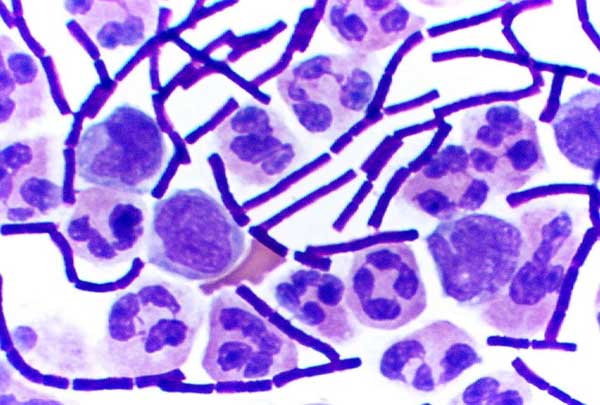
Pasteur proceeded with the development of bacteriology and its relation to disease. Having studied many cases of child-bed fever at the hospitals, he declared before a medical society that he had seen its cause, and challenged he drew a picture resembling a rosary of what we now know as a streptococcus, or chain coccus. He discovered other coccus (berry) forms of pathological microbes, some of them arranged in bunches like grapes, thence called staphylococci. Finally came his work on rabies. Unable to find the cause of the disease, which has not yet been discovered, he succeeded in making from the dessicated spinal cords of animals dead from the disease a vaccinating virus, which protects human beings bitten by a rabid animal again the development of rabies. This treatment met with great opposition. The Germans talked sneeringly of "a remedy of which we know nothing for a disease of which we know less". With time Pasteur's vindication came. The Russians, who suffered severely from rabies, from the bites of mad wolves on the steppes, found it of great service, and the tsar honoured Pasteur by a personal visit. Next the British in India found it wonder-working. Other countries adopted it. Finally the German Government established Pasteur Institutes, and acclaimed the discovery.

Many honours came to Pasteur. Besides the Rumford and Copley Medals (1856-1874), in 1868 the Austrian Government gave him a prize of 10,000 francs for this work on silk- worms; in 1873 the French Société d'Encouragement, a prize of 12,000 francs; the Russian Society of Rural Economy, a medal (1882); the Albert medal (1882); the Bressa Prize, 5000 francs (Turin Academy, 1888); the French Government, an annual pension of 12,000 francs (1874), increased in 1883 to 25,000 francs, and besides all the degrees of the Legion of Honour orders were conferred on him by Russia, Denmark, Greece, Brazil, Sweden, Turkey, Norway, and Portugal. Oxford gave him a D.C.L., Bonn, an honorary M.D., the English Royal Society, foreign membership, and the French Academy, its membership (1881). He was made Perpetual Secretary of the Academy of Sciences in 1887. There was a magnificent celebration of his jubilee on his seventieth birthday, 27 December, 1892, to which contributions were sent from every civilized country and all the great institutions of learning.
Pasteur's faith was as genuine as his science. In his panegyric of Littré, whose fauteuil he took, he said:
Pasteur's principal works are: "Etudes sur Vin", (1866); "Etudes sur le Vinnaigre" (1868); "Etudes sur la Maladie des Vers à Soie" (2 vols., 1870); "Quelques Réflexions sur la Science en France" (1871); "Etudes sur la Bière" (1876); "Les Microbes organisés, leur rôle dans la Fermentation, la Putréfaction et la Contagion" (1878); "Discours de Réception de M.L. Pasteur à l'Académie Française" (1882); "Traitement de la Rage" (1886).
His discovery attracted wide attention. As a result he devoted himself to the study of what he called dissymmetry, pointing out that inorganic substances are not dissymmetrical in their crystallization, while all the products of vegetable and animal life are dissymmetric. He concluded that there was some great biological principle underlying this. As the result of his discovery he was made (1848) professor of physics at the Lycee of Dijon; three months later he became deputy professor of chemistry at the University of Strasburg, and full professor in 1852; in 1854 dean and professor of chemistry at the new University of Lille; in 1856 the English Royal Society conferred on him the Rumford Medal for researches on the polarization of light with hemihedrism of crystals; in 1857 he became director of scientific studies at the Paris Ecole Normal, in 1863 professor of geology and chemistry at the Ecole des Beaux Arts, in 1867 professor of chemistry at the Sorbonne, where he remained till 1889, when he became the Director of the Pasteur Institute, founded in his honour.
His early chemical studies led him to the investigation of fermentation and putrefaction, which he showed were due to living germs of various kinds. From this the demonstration that spontaneous generation does not take place was but a step. He showed that in highly-organized material, if the living germs are all destroyed, and if further access of germs be prevented, even though air may be allowed free access, fermentation or putrefaction does not take place. A piece of cotton wool, or a mere bending of the neck of the flask to keep germs from entering, is sufficient after sterilization to keep organic solutions quite sterile. The study of fermentations led Pasteur to studies in vinegar, wine, and beer. As the result of his successful investigation of ferments he was asked by the Empress Eugenie whether he would not now devote himself to the organization of great manufacturing industries for the benefit of France. He replied that he considered it quite beneath the dignity for a scientist to give up his time to commerce, and while he was willing that others should take advantage of his discoveries he wanted to push on to further scientific work.
This was a fortunate decision. His successful investigations led the French Government to appeal to him to study the silk-worm disease. This had produced such ravages in the silk industry in France that the end of it seemed not far off. Many expedients and supposed remedies had been tried. Fresh silk-worms had been brought from China on a number of occasions, but they succumbed to the disease, or their progeny became affected by it. Nothing availed and the case seemed hopeless. Pasteur found the silk-worm had been suffering from two diseases, pebrine and flacherie, and that the spread of these diseases could be prevented by careful segregation of healthy worms from those diseased. The announcement seemed too good to be true and was scouted. Pasteur demonstrated its absolute truth and his practical ability by taking charge of the villa of the French Prince Imperial, where the silk industry had been ruined. At the end of the year the sale of cocoons gave a net profit of 26,000,000 francs (over $5,000,000).
Naturally Pasteur proceeded to the study of diseases of animals and human beings. He demonstrated the bacterial cause of anthrax, which had made serious ravages among cattle in France. The organism was distributed by contact, real contagion. Earthworms, he showed, carry it up from the bodies of animals buried in shallow graves to infect grazing animals. He found further that he could by heat reduce the vitality of the anthrax microbe, so that it produced but a mild form of the disease which would protect cattle against the fatal form. Then he discovered the cause of fowl cholera. He cultivated it artificially and after a time his cultures would not produce the disease in fowl, though it served to protect them against injections of virulent cultures which would kill "control" fowl. The discoveries of vaccinating viruses for these two diseases saved France millions of dollars every year.
Pasteur proceeded with the development of bacteriology and its relation to disease. Having studied many cases of child-bed fever at the hospitals, he declared before a medical society that he had seen its cause, and challenged he drew a picture resembling a rosary of what we now know as a streptococcus, or chain coccus. He discovered other coccus (berry) forms of pathological microbes, some of them arranged in bunches like grapes, thence called staphylococci. Finally came his work on rabies. Unable to find the cause of the disease, which has not yet been discovered, he succeeded in making from the dessicated spinal cords of animals dead from the disease a vaccinating virus, which protects human beings bitten by a rabid animal again the development of rabies. This treatment met with great opposition. The Germans talked sneeringly of "a remedy of which we know nothing for a disease of which we know less". With time Pasteur's vindication came. The Russians, who suffered severely from rabies, from the bites of mad wolves on the steppes, found it of great service, and the tsar honoured Pasteur by a personal visit. Next the British in India found it wonder-working. Other countries adopted it. Finally the German Government established Pasteur Institutes, and acclaimed the discovery.
Many honours came to Pasteur. Besides the Rumford and Copley Medals (1856-1874), in 1868 the Austrian Government gave him a prize of 10,000 francs for this work on silk- worms; in 1873 the French Société d'Encouragement, a prize of 12,000 francs; the Russian Society of Rural Economy, a medal (1882); the Albert medal (1882); the Bressa Prize, 5000 francs (Turin Academy, 1888); the French Government, an annual pension of 12,000 francs (1874), increased in 1883 to 25,000 francs, and besides all the degrees of the Legion of Honour orders were conferred on him by Russia, Denmark, Greece, Brazil, Sweden, Turkey, Norway, and Portugal. Oxford gave him a D.C.L., Bonn, an honorary M.D., the English Royal Society, foreign membership, and the French Academy, its membership (1881). He was made Perpetual Secretary of the Academy of Sciences in 1887. There was a magnificent celebration of his jubilee on his seventieth birthday, 27 December, 1892, to which contributions were sent from every civilized country and all the great institutions of learning.
Pasteur's faith was as genuine as his science. In his panegyric of Littré, whose fauteuil he took, he said:
Happy the man who bears within him a divinity, an ideal of beauty and obeys it; and ideal of art, and ideal of science, an ideal of country, and ideal of the virtues of the Gospel.These words are graven above his tomb in the Institut Pasteur. In his address Pasteur said further "These are the living springs of great thoughts and great actions. Everything grows clear in the reflections from the Infinite". Some of his letters to his children breathe profound simple piety. He declared "The more I know, the more nearly is my faith that of the Breton peasant. Could I but know all I would have the faith of a Breton peasant woman." What he could not above all understand is the failure of scientists to recognize the demonstration of the existence of the Creator that there is in the world around us. He died with his rosary in his hand, after listening to the life of St. Vincent de Paul which he had asked to have read to him, because he thought that his work like that of St. Vincent would do much to save suffering children.
Pasteur's principal works are: "Etudes sur Vin", (1866); "Etudes sur le Vinnaigre" (1868); "Etudes sur la Maladie des Vers à Soie" (2 vols., 1870); "Quelques Réflexions sur la Science en France" (1871); "Etudes sur la Bière" (1876); "Les Microbes organisés, leur rôle dans la Fermentation, la Putréfaction et la Contagion" (1878); "Discours de Réception de M.L. Pasteur à l'Académie Française" (1882); "Traitement de la Rage" (1886).
Subscribe to:
Posts (Atom)