Italy 1631-1687
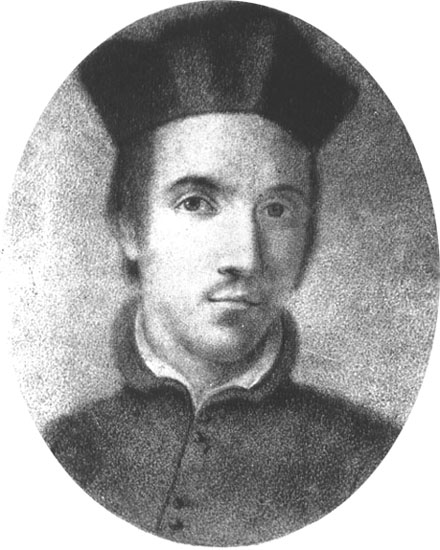
The Italian Jesuit is famous as the Father of Aeronautics because of his idea to create a flying machine based in (nearly completely) sound science. (1) He planned to use spheres of copper, with vacuums inside, to produce the necessary lift, having calculated the necessary size to sustain itself along with passengers. (1) His design is interesting because it used known, functional, technology of the day with strict mathematical calculations and scientific theories to create a successful design. (1, 3)
However, there were a number of considerations that prevented its construction. Lana de Terzi attempted to respond to these in his book, such as the idea that the riders of the flying machine would be flown into space. (1) Lana de Terzi responded that the weight of the ship would prevent the vacuum-filled balloons from reaching outer space, and that onboard valves would reintroduce air to the spheres and provide the capability of successful landing. (1) As for the claim that his balloons would not stand up against atmospheric pressure, he argued the spherical shape would help to withstand the pressure. This idea is flawed, though an interesting attempt.
However, one of the reasons he was wrong on this point was that he never constructed the machine, and this for several reasons.(4) First and foremost, his vow of poverty. (1) Lana de Terzi had calculated there was no way for him to fund the machine on his own, and consequently was forced to rely solely on theory. (1) One of the more existential issues was the threat to all civilization. (1) He feared such airships could be used to lay waste to cities with impudence, raining down destruction with any manner of projectile. When aircraft actually were created, this fear came to fruition within fifty years, so he was correct to consider the threatening possibilities of flight(1)
It is extremely interesting that we consider him the father of Aeronautics despite all of these considerations and limitations. Lastly, it has been alleged that his ideas were essentially just, reused versions of others’ work. (4) But all of this is fails to see the rest of his work.
His idea for a flying machine was published in a book which was entitled -- in part -- ‘Promodero, wise overseer of some new inventions’ ( A link which contains pdf verison photographed in the original Italian is here https://www.e-rara.ch/zut/content/titleinfo/9958403). (1, 3). However, the idea for constructing the balloon airship only took up only one of the chapters of the volume. The previous chapter was dedicated to the idea of flight similar to that of birds, and between them Lana de Terzi distinguished between heavier than air flight and lighter than air flight. (3)
However, outside of those two chapters, the rest of the book was not concerned with flight at all. Instead, the purpose of the book was twofold: To explain the myriad inventions he had theorized and to generate attention for his actual scientific work. (1, 3) One of his ideas was to create a language for the blind, which was actually extremely similar to braille despite preceding Louis Braille by over 150 years. His design was groundbreaking because it relied on a series of dashes to communicate the language rather than attempting to stick directly to the traditional alphabet, as the systems of the time did. Much like his idea for flight, the invention was never actually completed, though it is quite a compelling idea. (5)
The scientific knowledge which Lana de Terzi was publicizing was a planned nine-volume work, named Mastery of Nature and Art, to encapsulate the natural sciences and based in certainty through experiments and geometry. (3) He only managed to publish two, though another was published after his death. (3)
He was also interesting because he was trying to change the accepted ideas of the day in regard to ancient philosophers and magnetism. Lana de Terzi wished to have a variety of sources in use, and compare and contrast them rather than assuming a single source will have all the answers. He argued that science was inhibited by unnecessary fixations on particular sources, such as Aristotle. (2) Lana de Terzi’s attitude was that if Aristotle was wrong, as he was bound to be at some point, one must be willing to learn from some other scientist. (2)
Lana de Terzi was not the only scientist with these claims, but rather represented the new trend of scientists who wished to break with tradition where it did not function. In particular, he was frustrated by the idea that materials’ qualities were part of their ‘nature.’ He remarked annoyedly that if you asked nearly any natural philosopher of his day about anything they would say it was simply “such is the nature of that substance… [why does] a magnet draw iron and not straw, and amber draw straw and not iron?’ They reply this is the nature of amber and that is the nature of the magnet.” (2, pg 17). Altogether a circular argument and therefore unhelpful. Lana de Terzi wanted to break from this tradition by examining the actual causes of the world, hence his attempt at a nine volume collection of science.
It is rather sad then, that we remember him for only his airship. While it relied on a new piece of technology, the vacuum pump, it fails to really show what Lana de Terzi wished to do. (1) It shows that he knew how to predict possible issues with aircraft, but it ignores his desire to revolutionize science. Of all his work, we remember one chapter of the one book he created to generate enough publicity to sell his actual science and this one achievement wasn’t even something that he actually accomplished, nor was it necessarily something he wanted to have happen.
Works Referenced
- Francesco Lana-Terzi, S. J. (1631-1687 The Father of Aeronautics http://www.faculty.fairfield.edu/jmac/sj/scientists/lana.htm
- Elements of Early Modern Physics https://books.google.com/books?id=vBH0vBmG61IC&pg=PA163&dq=Elements+of+Early+Modern+Physics+By+J.+L.+Heilbron+#v=onepage&q=lana&f=false
- Francesco Lana http://www.newadvent.org/cathen/08772c.htm
- The Rational Mechanics of Flexible Or Elastic Bodies https://books.google.com/books?id=gxrzm6y10EwC&printsec=frontcover&source=gbs_ge_summary_r&cad=0#v=onepage&q=francesco%20&f=false
- Foundations of Opthalmology: Great Insights that established the discipline https://books.google.com/books?id=4kszDwAAQBAJ&pg=PA46&lpg=PA46&dq

